Learning piano key names is one of the first steps toward playing music. Whether you are a beginner or helping a child learn piano, understanding the keys makes it easier to read music, practice scales, and play songs.
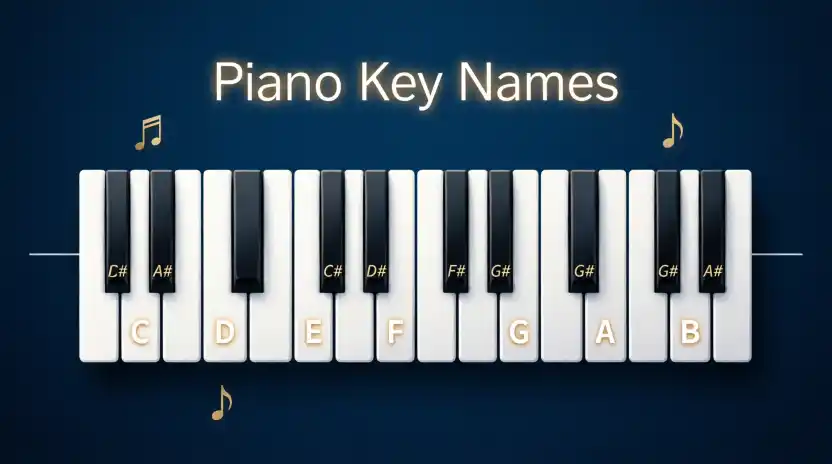
A standard full-size piano has 88 keys, including 52 white keys and 36 black keys. The white keys use the letter names A, B, C, D, E, F, and G. The black keys are named using sharps and flats, such as C-sharp (C♯) and D-flat (D♭).
Once you understand how these notes repeat across the keyboard, finding any key becomes much easier. This guide explains piano key names, the difference between white and black keys, and simple ways to remember their positions.
What Are the Names of Piano Keys?
Piano keys are named after seven musical notes: A, B, C, D, E, F, and G. These letters repeat in the same order across the keyboard.
The white keys represent the basic natural notes. Black keys represent notes that can be named with sharps or flats.
Here are the seven natural piano notes:
- A: One of the seven basic musical notes.
- B: The natural note immediately before C.
- C: A useful starting point for learning the keyboard.
- D: The natural note between C and E.
- E: The natural note immediately before F.
- F: The natural note immediately before G.
- G: The last note in the basic letter sequence before it repeats at A.
After G, the note names start again at A. This repeating pattern helps you identify keys across the entire piano.
White Piano Key Names
The white keys are the easiest place to start when learning the piano. Their names follow the repeating sequence A, B, C, D, E, F, and G.
Each white key has a natural note name. For example, moving from C to the right gives you D, E, F, G, A, B, and then the next C.
The white keys are not all separated by the same distance in musical pitch. There is a half-step between E and F and between B and C. Between the other neighboring natural notes, there is a whole step.
List of White Piano Keys
The seven white key names are:
- A — Natural note
- B — Natural note
- C — Natural note
- D — Natural note
- E — Natural note
- F — Natural note
- G — Natural note
These seven notes repeat in higher and lower octaves across the keyboard.
Black Piano Key Names
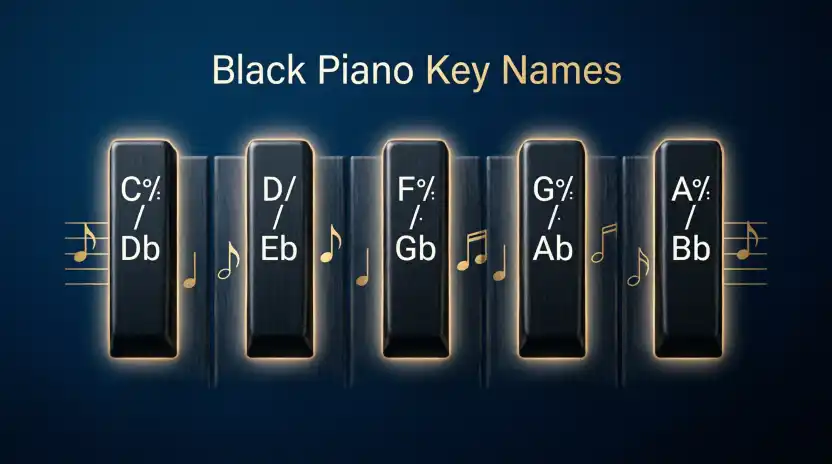
Black keys are found in groups of two and three across the piano. Each black key can usually be named in two ways, depending on the musical context.
For example, the black key between C and D can be called C-sharp (C♯) or D-flat (D♭). These two names refer to the same physical key on a standard piano.
Names of the Black Keys
The five black-key positions within an octave have these common names:
- C♯ or D♭: The black key between C and D.
- D♯ or E♭: The black key between D and E.
- F♯ or G♭: The black key between F and G.
- G♯ or A♭: The black key between G and A.
- A♯ or B♭: The black key between A and B.
Notice that there is no black key between E and F or between B and C. These natural notes are already a half-step apart.
Piano Key Names in Order
Learning the notes in order makes it easier to find any key. The pattern below shows one octave, beginning on C and ending on the next C.
The note sequence is:
C – C♯/D♭ – D – D♯/E♭ – E – F – F♯/G♭ – G – G♯/A♭ – A – A♯/B♭ – B – C
This sequence includes all 12 semitones in an octave. The final C is one octave higher than the first C.
Remember that the black keys have alternative names. The physical key stays the same even when its musical name changes.
How to Find C on the Piano
Finding C is one of the easiest ways to begin learning the keyboard. Look for a group of two black keys. The white key immediately to the left of that group is C.
Follow these steps:
- Find any group of two black keys.
- Look at the white key directly to their left.
- That white key is C.
- Move right to find D and E.
- Continue to F, G, A, and B.
- The next white key is C again.
This pattern works across the piano, from the lower notes on the left to the higher notes on the right.
Understanding the Groups of Black Keys
Black keys appear in repeating groups of two and three. These groups help you recognize notes without counting every key.
Groups of Two Black Keys
The two black keys are C♯/D♭ and D♯/E♭.
The white keys around this group are C, D, and E. C is immediately to the left of the group, D is between the two black keys, and E is immediately to the right.
Groups of Three Black Keys
The three black keys are F♯/G♭, G♯/A♭, and A♯/B♭.
The white keys around this group are F, G, A, and B. F is to the left of the group, while G and A sit between the black keys. B is to the right.
Learning these two patterns makes it much easier to navigate the entire keyboard.
How Many Keys Does a Piano Have?
A standard full-size acoustic piano has 88 keys. These include 52 white keys and 36 black keys.
The 88 keys usually cover seven full octaves plus a few additional notes at the ends. Smaller keyboards may have fewer keys, such as 61 or 76.
Here is a quick breakdown:
- 88 keys: Standard full-size piano.
- 52 white keys: Natural notes arranged across the keyboard.
- 36 black keys: Keys used for sharps and flats.
- 7 natural note names: A, B, C, D, E, F, and G.
- 12 semitones per octave: Seven natural-note positions and five black-key positions.
The number of keys can vary depending on the instrument. However, the basic note pattern remains the same.
What Are Octaves on a Piano?
An octave is the distance between one musical note and the next note with the same letter name at a higher or lower pitch.
For example, if you play one C and then the next higher C, you have moved up one octave. The higher C sounds brighter, but both notes share the same letter name.
Each octave contains 12 semitones. The pattern of seven natural notes and five black-key positions repeats throughout the keyboard.
Octaves help musicians organize notes and recognize familiar patterns. Once you learn the note names in one octave, you can use the same pattern to find notes in other octaves.
Piano Key Names for Beginners
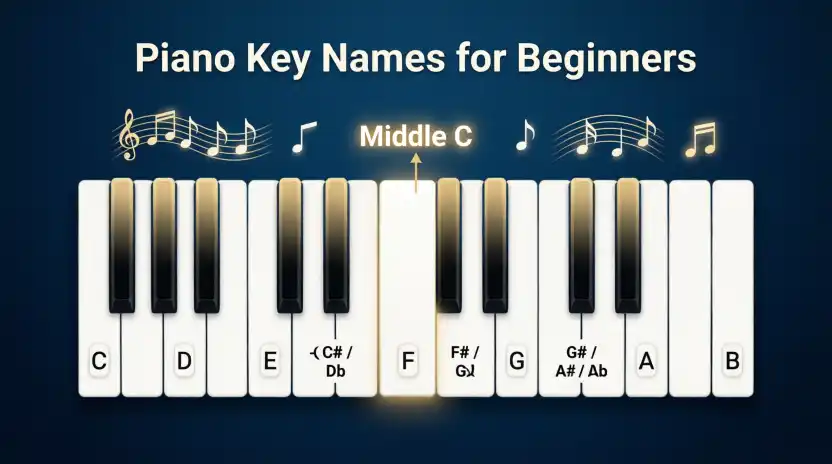
If you are new to piano, focus on recognizing the keys before trying to memorize everything at once.
Start With Middle C
Middle C is a useful reference point for beginners. On a standard piano, it is near the center of the keyboard and is commonly used as a starting point for basic lessons.
Find a group of two black keys near the middle. The white key just to their left is Middle C.
Learn the Seven White Notes
Practice saying the note names in order:
C, D, E, F, G, A, B.
Then continue to the next C and repeat the sequence. Practice moving both to the right and to the left.
Recognize the Black Keys
Learn the black-key names in groups. Start with C♯/D♭ and D♯/E♭, then learn F♯/G♭, G♯/A♭, and A♯/B♭.
You do not need to memorize every alternative name on the first day. Begin by identifying each black key’s position.
Practice Every Day
Spend a few minutes naming random keys. Point to a white or black key, say its name, and check your answer.
Short, regular practice sessions can help you become familiar with the keyboard.
Easy Ways to Memorize Piano Key Names
Memorizing piano keys becomes easier when you use visual patterns and simple practice activities.
Use the Two-Black-Key Pattern
Find two black keys and identify the white key immediately to their left as C. This gives you a reliable starting point anywhere on the keyboard.
Say the Notes Out Loud
Repeat the sequence C, D, E, F, G, A, B. Then start at A and practice moving through A, B, C, D, E, F, and G.
Practice With Random Keys
Choose a key without following the normal sequence. Name it, then find another key with the same letter in a different octave.
Learn One Octave at a Time
Begin with the notes around Middle C. Once you recognize these keys, expand your practice toward the lower and higher ends of the piano.
Use Note Labels Carefully
Labels can help beginners, but try to practice without them as you improve. Recognizing the black-key groups is a useful long-term skill.
Frequently Asked Questions About Piano Key Names
1. What are the seven piano key names?
The seven natural piano key names are A, B, C, D, E, F, and G. These notes repeat in the same order across the keyboard.
2. What are the names of the black keys on a piano?
The black keys are commonly named C♯/D♭, D♯/E♭, F♯/G♭, G♯/A♭, and A♯/B♭. Each pair of names refers to the same physical key on a standard piano.
3. Why is there no black key between E and F?
E and F are already one half-step apart in standard Western music. The same is true of B and C, so there is no additional black key between either pair.
4. How many keys does a standard piano have?
A standard full-size piano has 88 keys: 52 white keys and 36 black keys. Some digital keyboards have fewer keys.
5. How can I find C on a piano?
Find a group of two black keys. The white key immediately to the left of that group is C. You can use this pattern to locate every C on the keyboard.
6. Are C-sharp and D-flat the same key?
Yes. On a standard piano, C-sharp and D-flat refer to the same physical key. These notes are called enharmonic equivalents because they share a pitch in standard equal temperament but have different written names.
7. What is Middle C?
Middle C is a C note near the center of a standard piano keyboard. It is an important reference point for beginners and is commonly used in basic music lessons.
8. How do I memorize all piano keys?
Start by learning the groups of two and three black keys. Use them to locate C, then practice the seven natural notes and the five black-key positions in one octave before expanding to the rest of the keyboard.
Conclusion
Learning piano key names is an important first step for anyone who wants to play music. Start with the seven natural notes—A, B, C, D, E, F, and G—and learn how they repeat across the keyboard.
Next, recognize the groups of two and three black keys and practice their sharp and flat names. With regular practice, you will be able to find notes more quickly and feel more comfortable reading music.
Read more about!
- 200+ French Names for Dogs: Cute, Unique, and Meaningful Ideas
- 100+ Ben Dover Type Names: Funny, Cheeky, and Clever Prank
- 200+ Dark Blue Names: Cool, Aesthetic, and Creative Ideas

I’m Noah Wilson, a name enthusiast and writer at NamesProx. I enjoy researching and sharing creative, meaningful, and unique name ideas, from baby and pet names to character, fantasy, cultural, and business names. My goal is to make finding the perfect name simple, enjoyable, and useful for everyone.