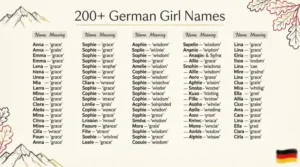
German girl names offer a beautiful mix of classic charm, modern style, and cultural history. Some names, such as Emma and Hannah, are familiar around the world. Others, such as Adelheid, Hildegard, and Gretchen, have a more traditional German feel.
If you are choosing a baby name, creating a character, or exploring German naming traditions, this list can help you find the right option. You will discover beautiful German girl names, traditional favorites, short and cute choices, rare ideas, and names with meanings or historical connections.
Best German Girl Names
These German girl names are a great starting point if you want a name that is attractive, recognizable, and easy to use.
- Emma — A classic name with Germanic roots, often associated with the idea of wholeness or universality.
- Hannah — A form of a Hebrew name meaning “grace” or “favor.”
- Mia — A short, popular name used in Germany and many other countries.
- Emilia — A feminine name related to the Roman family name Aemilius.
- Lina — A short name that can be a standalone name or a shortened form of longer names.
- Clara — A form of the Latin name Clarus, meaning “clear” or “bright.”
- Lena — Often used as a short form of Helena or Magdalena.
- Anna — A traditional name derived from Hannah.
- Sophie — A form of Sophia, meaning “wisdom.”
- Marie — A French and German form of Maria.
- Johanna — A feminine form of Johannes, derived from a Hebrew name meaning “God is gracious.”
- Leonie — A feminine name related to the Latin word for “lion.”
- Amelie — A French form used in German-speaking countries, related to names associated with work or effort.
- Luisa — A feminine form related to Ludwig, a Germanic name often interpreted as “famous warrior.”
- Charlotte — A feminine form of Charles, which has Germanic roots.
- Greta — Traditionally a short form of Margareta.
- Paula — A feminine form of Paulus, meaning “small” or “humble.”
- Matilda — A Germanic name often interpreted as “strength in battle.”
- Frieda — A German name related to the Germanic element frid, meaning “peace.”
- Elsa — A short form of Elisabeth.
Traditional German Girl Names
Traditional German names often reflect older Germanic languages, Christian naming customs, and centuries of European history. These choices are especially appealing if you want a name with a classic feel.
Classic German Names
- Adelheid — A traditional Germanic name formed from elements associated with nobility and kind or type.
- Adelina — A name related to the Germanic element adal, meaning “noble.”
- Anneliese — A traditional compound name combining Anna and Liese, a form of Elisabeth.
- Brunhilde — A Germanic name traditionally associated with armor and battle.
- Gertrud — A traditional Germanic name with elements associated with a spear and strength.
- Gisela — A traditional German name whose early meaning is not completely certain.
- Hedwig — A Germanic name traditionally associated with battle.
- Hildegard — A Germanic name formed from elements meaning “battle” and “enclosure” or “protection.”
- Irmgard — A traditional Germanic name associated with the elements ermen and gard.
- Kunigunde — An old Germanic name traditionally associated with family or kin and battle.
- Lieselotte — A compound name formed from Liese and Lotte.
- Margarete — A German form of Margaret, derived from a Greek word meaning “pearl.”
- Ottilie — A feminine name related to the Germanic element aud, meaning “wealth” or “fortune.”
- Roswitha — An old Germanic name with historical use in German-speaking regions.
- Waltraud — A traditional Germanic name with elements associated with power and counsel.
- Wilhelmine — A feminine form of Wilhelm, traditionally interpreted as “resolute protector.”
- Theodora — A Greek-origin name meaning “gift of God,” also used in German-speaking countries.
- Elfriede — A traditional German name associated with older Germanic name elements.
- Bertha — A Germanic name connected with the idea of brightness.
- Mathilde — A form of Matilda, traditionally interpreted as “strength in battle.”
Old-Fashioned German Girl Names
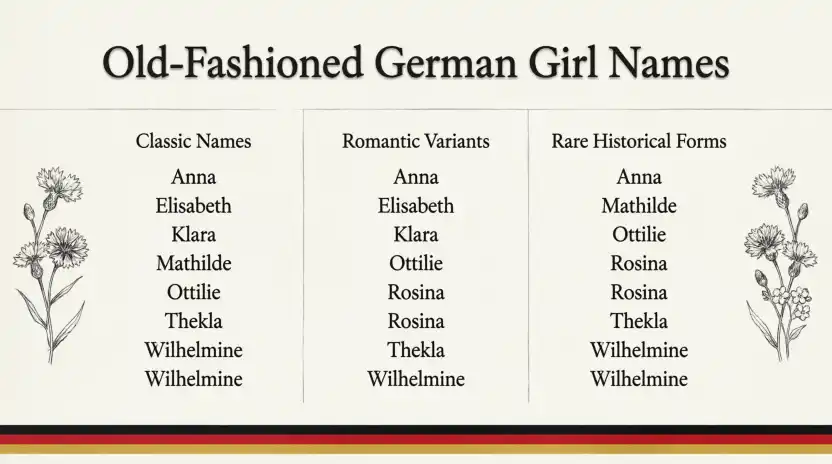
If you love vintage names, these choices bring an old-world atmosphere.
- Agnes — A name of Greek origin traditionally associated with purity.
- Almut — A traditional German name.
- Barbara — Derived from a Greek word meaning “foreign.”
- Berta — A variant of Bertha, associated with brightness.
- Dorothea — A Greek-origin name meaning “gift of God.”
- Edith — An Old English name meaning “riches” and “battle,” historically used in Germany too.
- Erika — A feminine form related to Erik.
- Eva — A form of Eve, traditionally associated with life.
- Hannelore — A German compound name combining elements of Hannah and Eleonore.
- Helga — A Scandinavian-origin name also used in Germany, associated with holiness or blessedness.
- Ingeborg — An Old Norse name used in German-speaking countries.
- Käthe — A German diminutive of Katharina.
- Luise — A German form of Louise.
- Margot — A form of Margarete or Margaret.
- Meta — A traditional short form of Margarete in German-speaking regions.
- Ruth — A Hebrew-origin name traditionally associated with friendship.
- Therese — A form of Theresa, used in Germany and other European countries.
- Ursula — A Latin name traditionally interpreted as “little bear.”
- Vera — A name used in several European languages, with different possible origins.
- Wilma — A short form of Wilhelmine or related names.
Beautiful German Girl Names With Meanings
A name’s meaning can help you choose one that feels personal. The names below include well-established meanings or commonly accepted name origins.
- Adela — “Noble,” from a Germanic name element.
- Alberta — Feminine form of Albert, traditionally interpreted as “noble” and “bright.”
- Alice — Related to Adelaide, a name of Germanic origin associated with nobility.
- Amalia — Related to Germanic names built from the element amal, traditionally associated with work or effort.
- Audrey — An English name with Germanic historical roots through the older name Æðelþryð.
- Carla — Feminine form of Carl, related to the Germanic name tradition.
- Caroline — A feminine form related to Carolus or Charles.
- Charlotte — Feminine form of Charles.
- Claudia — A Roman name used in German-speaking countries.
- Ella — A name with several possible origins and uses in German-speaking countries.
- Emmeline — A name related to Germanic elements associated with work or effort.
- Franziska — Feminine form of Franz, the German form of Francis.
- Helena — A Greek-origin name traditionally associated with light or brightness, though the exact original meaning is debated.
- Ida — A name related to an old Germanic element associated with work or labor.
- Isolde — A medieval European name whose origin and meaning remain uncertain.
- Karla — A feminine form of Karl.
- Leopoldine — Feminine form of Leopold, a Germanic name traditionally associated with people and boldness.
- Magdalena — A name meaning “woman from Magdala,” derived from a place name.
- Nora — Often a short form of Eleonora or Honora.
- Theresia — A German-language form of Theresa.
Cute German Girl Names
Cute names often have short spellings, gentle sounds, or familiar nicknames. These German girl names can work well for babies, fictional characters, or anyone who prefers a sweet style.
- Anni
- Bibi
- Ella
- Emmi
- Feli
- Greti
- Hanni
- Heidi
- Ilse
- Jette
- Leni
- Lilli
- Lotti
- Maja
- Mimi
- Nele
- Nina
- Romy
- Tilda
- Trudi
- Anja
- Marlene
- Mieke
- Thea
- Winnie
Some names in this list are traditionally nicknames or short forms. For example, Leni can be a short form of Helena or Magdalena, while Lotti is often used for Charlotte.
Unique and Rare German Girl Names
If you want a name that feels less common or more distinctive, consider these traditional, regional, or less frequently encountered choices. How rare a name is depends on the year and location.
- Alwine — A traditional Germanic name.
- Aloisia — A feminine form related to Aloysius.
- Armgard — A traditional Germanic name.
- Benigna — A Latin-origin name meaning “kind” or “benevolent.”
- Christl — A German diminutive associated with Christine or Christa.
- Dagmar — A name of Old Norse origin used in Germany.
- Edeltraud — A traditional German name.
- Eike — A name used in German-speaking regions; gender use can vary.
- Elfrun — A rare Germanic-style name.
- Elke — A name used in German-speaking regions, with uncertain historical origins.
- Fritzi — A German nickname related to Friederike or Friedrich.
- Gundula — A traditional Germanic name.
- Imke — A name especially associated with northern Germany and nearby regions.
- Irmelin — A rare name used in German-speaking contexts.
- Jorinde — A name known from German literary and fairy-tale tradition.
- Kriemhild — A name associated with the medieval German epic Nibelungenlied.
- Mechthild — A traditional German form related to Mathilde.
- Nadja — A name used in German-speaking countries, derived through Slavic forms of Nadia.
- Oda — A short Germanic name associated with wealth or fortune.
- Rike — A short form of names such as Friederike or Henrike.
- Senta — A name used in German-speaking countries and associated with German opera and literature.
- Svea — A Scandinavian name also found in Germany.
- Uta — A traditional German name.
- Wiebke — A name particularly associated with northern Germany.
- Xenia — A Greek-origin name used in Germany and elsewhere.
Modern German Girl Names

Modern naming styles include short international names, traditional names that have become fashionable again, and names that are easy to pronounce in several languages.
- Alina
- Amira
- Ava
- Carla
- Ella
- Emilia
- Emilie
- Emma
- Fiona
- Ida
- Jana
- Johanna
- Lara
- Lea
- Leonie
- Lia
- Lotta
- Luna
- Mila
- Mira
- Nele
- Paulina
- Ronja
- Sina
- Zoe
These names vary in origin. Some have Germanic roots, while others entered German naming culture from Greek, Latin, Hebrew, Slavic, or other languages. A name can be popular in Germany without having originated there.
Short German Girl Names
Short names are easy to spell, say, and remember. Many also work well internationally.
- Ada — A short name related to Germanic names associated with nobility.
- Alma — A name with several possible linguistic origins.
- Anja — A form of Anna used in German-speaking regions.
- Eva — A form of Eve.
- Hedi — A short form of Hedwig or other names.
- Ines — A form of Agnes used in several European languages.
- Jana — A name used in Germany and other European countries.
- Jule — A German name often related to Julia.
- Kira — A name with multiple possible origins.
- Lara — A short international name used in Germany.
- Lea — A biblical name with several possible interpretations.
- Leni — A familiar German short form.
- Lilo — A short name used in German-speaking countries.
- Mara — A short name with several cultural origins.
- Mina — A name that can be a short form of longer names.
- Nika — A short name used in several languages.
- Romy — A name associated with Rosemary or Romana in some naming traditions.
- Rosa — The Latin word for “rose.”
- Tina — A short form of names such as Christina.
- Tove — A Scandinavian name also recognizable in Germany.
German Girl Names That Start With A
If you are searching alphabetically, these names offer a mix of traditional and modern options.
- Ada
- Adela
- Adelheid
- Adelina
- Agnes
- Alberta
- Alina
- Alma
- Amalia
- Amelie
- Amalia
- Anja
- Anna
- Anne
- Anneliese
- Annika
- Antonia
- Ava
- Aurelia
- Augusta
Girl Names That Start With E
- Edda
- Edeltraud
- Edith
- Elena
- Eleonore
- Elfriede
- Elisa
- Elisabeth
- Ella
- Elsa
- Emilia
- Emilie
- Emma
- Emmi
- Erika
- Esther
- Eva
- Evelyn
- Evi
- Elke
Girl Names That Start With L
- Lara
- Laura
- Lea
- Leah
- Lena
- Leni
- Leonie
- Leopoldine
- Lia
- Liesel
- Lieselotte
- Lilli
- Lina
- Linda
- Lisa
- Lotte
- Lotti
- Louisa
- Luisa
- Luna
German Girl Names That Start With M
- Maja
- Mara
- Margarete
- Margot
- Maria
- Marie
- Marieke
- Marina
- Marlene
- Martha
- Mathilda
- Matilda
- Mechthild
- Mia
- Mila
- Mina
- Mira
- Miriam
- Mona
- Morgane
German Girl Names and Pronunciation Tips
Learning a few basic patterns can make it easier to say German names correctly.
- J is usually pronounced like the English “y” in “yes.” For example, Jana begins with a “y” sound.
- W is usually pronounced like the English “v.” The name Wilma begins with a “v” sound.
- V is often pronounced like “f” in traditional German words and names, though exceptions exist.
- Z is usually pronounced like “ts.”
- Ä often sounds similar to the vowel in “bed,” depending on the word and speaker.
- Ö has no exact equivalent in standard English. It is produced with rounded lips and a vowel sound similar to the one in German schön.
- Ü also requires rounded lips and has no exact English equivalent.
For an accurate pronunciation, check a German dictionary or a reliable pronunciation recording for the specific name.
How to Choose the Right German Girl Name
Choosing a name becomes easier when you decide what matters most to you.
Consider the Meaning
If meaning is important, start with names that have well-established origins. For example, Sophie means “wisdom,” Clara is associated with “brightness” or “clarity,” and Margarete is derived from a Greek word meaning “pearl.”
Think About Family and Cultural Connections
A traditional name such as Adelheid or Hildegard may honor German family heritage. An international choice such as Emma, Anna, or Emilia may feel more familiar across different languages.
Decide Between Traditional and Modern Styles
Traditional names often have a historic feel, while shorter choices such as Mia, Lina, and Ella sound modern to many people. Both styles can work well, depending on your preference.
Check Spelling and Pronunciation
Names with umlauts or less familiar German letter combinations may need explanation in countries where German is not widely spoken. Consider if the name will be easy to pronounce in your family’s language.
Check Current Popularity if It Matters
Popularity changes by year. If you want a name that is currently popular or genuinely rare in Germany, consult official German birth-name statistics or a trusted name-data source instead of relying on an undated list.
Frequently Asked Questions About German Girl Names
1. What are the most beautiful German girl names?
Many people find Emma, Emilia, Clara, Sophie, Lena, Anna, Greta, and Johanna appealing. The best choice depends on if you prefer a traditional, modern, short, or meaningful name.
2. What are some traditional German girl names?
Traditional choices include Adelheid, Anneliese, Brunhilde, Gertrud, Gisela, Hedwig, Hildegard, Kunigunde, and Wilhelmine. Many have Germanic roots or a long history of use in German-speaking regions.
3. What are popular German girl names?
Emma, Emilia, Hannah, Mia, Sophia, Lina, and Ella are examples of names widely used in German-speaking countries. Exact popularity rankings change over time, so check recent official statistics for a particular year.
4. What are rare German girl names?
Distinctive choices include Alwine, Armgard, Edeltraud, Elfriede, Mechthild, Wiebke, and Waltraud. Their current rarity depends on the region and generation.
5. What German girl names have beautiful meanings?
Sophie means “wisdom,” Clara is associated with “clear” or “bright,” Margarete means “pearl” through its Greek origin, and Frieda is associated with peace. Always check the specific form and historical origin of a name.
6. What are cute German girl names?
Cute choices include Leni, Lilli, Lotti, Emmi, Anni, Jette, Maja, Nele, and Romy. Some are standalone names, while others are traditional diminutives or short forms.
7. What are old-fashioned German girl names?
Vintage options include Agnes, Berta, Dorothea, Edith, Hannelore, Helga, Käthe, Margot, and Ursula. These names may appeal to people who like historical or classic styles.
8. What are short German girl names?
Short options include Ada, Alma, Anja, Eva, Jule, Lea, Lena, Lia, Mia, Nina, Rosa, and Thea. Several are used internationally, so they can be practical in multilingual families.
9. Are all German girl names originally German?
No. German naming traditions include names from Germanic languages as well as Hebrew, Greek, Latin, French, Slavic, and other languages. A name can be common in Germany without having originated there.
10. How can I find a German girl name that is popular today?
Look for current name statistics from Germany’s official statistical agencies or established German name-data organizations. Check the publication year and if the list represents all births or a particular region.
Conclusion
German girl names offer something for every style, from timeless classics such as Anna and Clara to traditional names such as Adelheid and Hildegard. Modern options such as Mia, Emilia, and Lina are easy to recognize, while names such as Wiebke, Mechthild, and Alwine offer a more distinctive choice.
Before choosing a name, consider its meaning, pronunciation, cultural background, and popularity. The best German girl name is one that feels meaningful to you and suits the person or character who will carry it.
Read more about!
- Names for Stories: 200+ Creative, Unique, and Catchy Ideas
- Famous Pirates Names: 100+ Legendary, Real, and Female Pirates
- 150+ Thai Names:Thailand Names for Boys, Girls, and More

I’m Noah Wilson, a name enthusiast and writer at NamesProx. I enjoy researching and sharing creative, meaningful, and unique name ideas, from baby and pet names to character, fantasy, cultural, and business names. My goal is to make finding the perfect name simple, enjoyable, and useful for everyone.