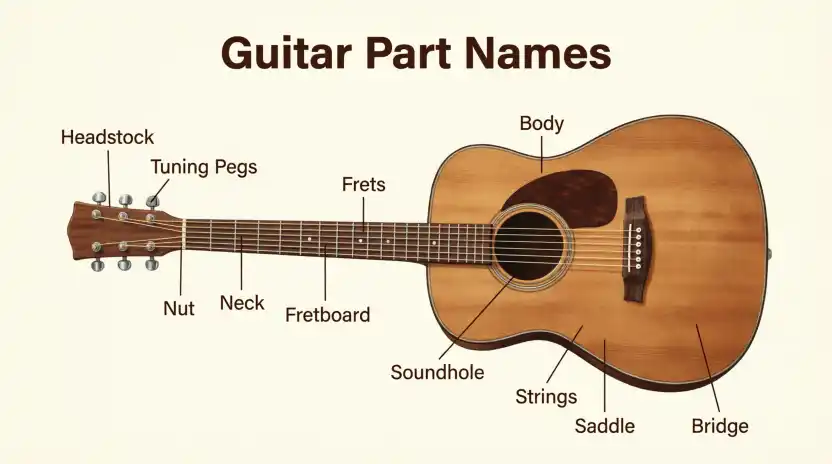
Guitar parts include the headstock, tuning pegs, nut, neck, fretboard, frets, strings, body, and bridge. Acoustic guitars usually have a sound hole and soundboard, while electric guitars use pickups and electronic controls. Learning these names helps beginners understand guitar lessons, tune their instruments, and care for their guitars.
Main Parts of a Guitar
Most guitars have three main sections: the headstock, neck, and body. Each section contains smaller parts that help hold the strings, produce notes, and shape the instrument’s sound.
Headstock
The headstock sits at the top of the guitar. It holds the tuning machines, which allow players to adjust string tension and pitch.
Neck
The neck connects the headstock to the body. It supports the fretboard and provides the playing surface for forming notes and chords.
Body
The body is the largest part of the guitar. It supports the bridge and other components. An acoustic guitar uses a hollow body to project sound, while an electric guitar uses pickups to send a signal to an amplifier.
Strings
Strings stretch from the tuning machines to the bridge. When players pluck or strum them, they vibrate and create sound.
Bridge
The bridge anchors or supports the strings at the body end. It also transfers string vibrations to the body on acoustic guitars.
Guitar Headstock Parts and Their Names
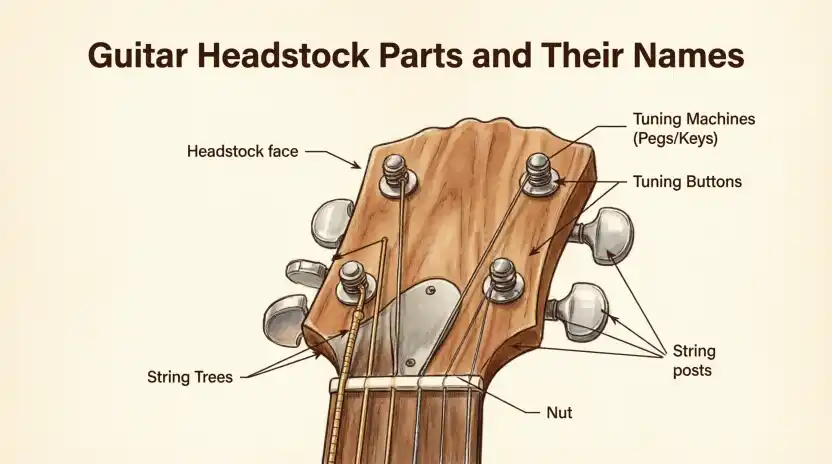
The headstock contains several parts that help keep the strings in place and allow players to tune their guitars.
Tuning Pegs
Tuning pegs, also called tuning keys or tuning machines, adjust string tension. Turning a peg changes the pitch of its string.
Nut
The nut is a small piece near the end of the fretboard. It guides the strings and helps maintain their spacing.
String Trees
String trees are small guides found on some electric guitar headstocks. They help maintain the correct string angle over the nut.
Headstock Logo
Many guitar makers place their logo or brand name on the headstock. This helps identify the manufacturer but does not directly produce sound.
Guitar Neck and Fretboard Parts
The neck and fretboard help players control pitch and play different notes. Several smaller parts also support the guitar’s structure and playability.
Fretboard
The fretboard, also called the fingerboard, is the surface where players press the strings. It is usually attached to the front of the neck.
Frets
Frets are thin metal strips placed across the fretboard. Pressing a string just behind a fret changes the vibrating length of the string and produces a different note.
Position Markers
Position markers are dots or decorative shapes on the fretboard. They help players find fret positions quickly. Many guitars also have markers along the side of the neck.
Truss Rod
A truss rod is a metal rod inside the neck of many guitars. It helps control the neck’s slight curve, known as neck relief.
Heel
The heel is the area where the neck joins the body. Its shape can affect how easily players reach the higher frets.
Neck Joint
The neck joint connects the neck to the body. Depending on the guitar, the neck may be bolted on, glued in place, or built as part of a continuous structure.
Guitar String Names and Numbers
A standard six-string guitar uses six strings tuned to different pitches. In standard tuning, the notes are E, A, D, G, B, and E, from the thickest string to the thinnest.
The Six Guitar Strings
- String 6: Low E — the thickest string.
- String 5: A.
- String 4: D.
- String 3: G.
- String 2: B.
- String 1: High E — the thinnest string.
Remember that string numbers run from the thinnest string (1) to the thickest string (6). This numbering remains the same regardless of how you hold the guitar.
String Windings
Many steel-string guitars use both plain and wound strings. Plain strings have no outer winding, while wound strings have metal wire wrapped around a core.
String Gauge
String gauge means string thickness. Lighter strings often feel easier to bend, while heavier strings can feel firmer under the fingers. The best gauge depends on the guitar, tuning, and playing style.
Acoustic Guitar Parts and Their Functions
Acoustic guitars use a vibrating soundboard and hollow body to project sound. Their construction differs from that of most solid-body electric guitars.Sound Hole
The sound hole is the opening found on many acoustic guitars. It helps sound radiate from the vibrating body.
Soundboard or Top
The soundboard is the front surface of the guitar body. String vibrations pass through the bridge and make the soundboard vibrate, helping produce the instrument’s acoustic sound.
Back
The back is the rear surface of the guitar body. It works with the sides and soundboard to shape the instrument’s acoustic response.
Sides
The sides connect the front and back of the guitar. Together, these parts form the hollow body of a typical acoustic guitar.
Saddle
The saddle sits in or on the bridge. It supports the strings and helps determine their height and vibrating length.
Bridge Pins
Bridge pins hold the string ends in place on many steel-string acoustic guitars. Some acoustic designs use other methods to secure their strings.
Pickguard
The pickguard protects the guitar’s top from scratches caused by picks or fingernails.
Strap Buttons
Strap buttons provide attachment points for a guitar strap. Their location depends on the guitar’s design.
End Pin
The end pin sits at the bottom of many acoustic guitars. It often provides a strap attachment point.
Electric Guitar Parts and Their Functions
Electric guitars use pickups to convert string vibrations into electrical signals. These signals can travel through a cable to an amplifier or other audio equipment.
Pickups
Pickups detect string vibrations and convert them into electrical signals. Many electric guitars use magnetic pickups, including single-coil and humbucker designs.
Pickup Selector Switch
The pickup selector lets players choose different pickups or combinations of pickups. This changes the tonal character of the guitar’s output.
Volume Knob
The volume knob adjusts the guitar’s output level. Its effect can also depend on the connected amplifier and other equipment.
Tone Knob
The tone knob changes the tonal balance of the signal. On many guitars, turning it down reduces high frequencies and creates a darker sound.
Output Jack
The output jack is where the guitar cable connects. It sends the guitar’s electrical signal to an amplifier or compatible audio device.
Bridge Saddles
Bridge saddles support the strings. Many electric guitar bridges allow players or technicians to adjust string height and intonation.
Tremolo or Vibrato Arm
Some electric guitars have a movable arm connected to a suitable bridge system. Moving the arm changes string tension and pitch.
Although commonly called a tremolo arm, it produces vibrato when it changes pitch. Tremolo technically refers to a change in volume.
Back Plate
Some electric guitars have a back plate covering a cavity that contains springs or other hardware. Its function depends on the guitar’s bridge design.
Classical Guitar Parts and Their Names
Classical guitars share many components with other acoustic guitars, but they have several distinctive features.
Nylon Strings
Classical guitars typically use nylon-based treble strings and wound bass strings. These strings generally feel different from steel strings.
Slotted Headstock
Many classical guitars have a slotted headstock. The tuning posts sit inside the slots, and the strings wind around them.
Tie Block
The tie block is part of the bridge on many classical guitars. Players tie the strings to it rather than securing them with steel-string acoustic bridge pins.
Wider Neck
Classical guitars often have wider necks than steel-string acoustic guitars. This gives the strings more space across the fretboard, although exact dimensions vary by model.
Guitar Parts Comparison: Acoustic vs. Electric
Acoustic and electric guitars share many basic components, but their sound-producing systems differ.
Acoustic Guitar Parts
- Soundboard or top
- Sound hole on many models
- Back and sides
- Bridge and saddle
- Bridge pins on many steel-string models
- Neck and fretboard
- Frets and strings
- Tuning machines
Electric Guitar Parts
- Body
- Neck and fretboard
- Frets and strings
- Tuning machines
- Pickups
- Pickup selector
- Volume and tone controls
- Bridge and saddles
- Output jack
Key Differences
An acoustic guitar projects sound through its vibrating body. An electric guitar uses pickups to produce an electrical signal, which usually passes through an amplifier.
Some acoustic-electric guitars have both acoustic components and electronic equipment, such as a built-in pickup or preamp.
Less Common Guitar Parts and Terms
These additional guitar terms are useful when buying, maintaining, or repairing an instrument.
Intonation Adjustment Screws
These screws appear on many adjustable electric guitar bridges. They move the saddles to help the guitar play in tune across the fretboard.
Pickup Covers
Pickup covers protect or conceal pickup components. Some pickups have exposed pole pieces instead.
Control Cavity
The control cavity is a space inside an electric guitar that houses electronic components, such as wiring, switches, and potentiometers.
Truss Rod Cover
Some guitars have a small cover over the truss rod access point. It protects the opening and may display a logo.
F-Holes
F-holes are curved openings found on many hollow-body and semi-hollow electric guitars. They resemble the openings on violins and other bowed string instruments.
Vibrato Springs
Some electric guitars use springs inside the body to balance string tension against a floating vibrato bridge.
Strap Lock
A strap lock is a fitting that helps keep the guitar strap securely attached. It can replace standard strap buttons.
How to Identify Guitar Parts Easily
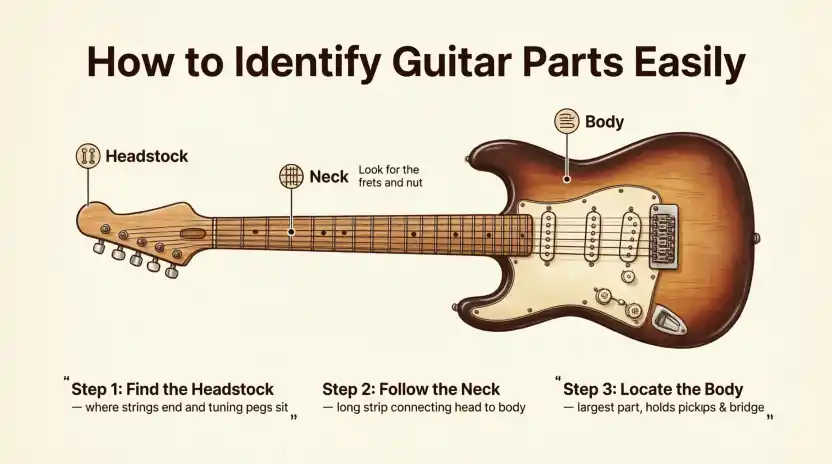
You do not need to memorize every component at once. Start with the main sections and learn the smaller parts as you become familiar with your instrument.
Follow the Guitar From Top to Bottom
- Top: Headstock and tuning machines.
- Below the headstock: Nut, neck, fretboard, and frets.
- Center: Body, with a sound hole on many acoustic guitars or pickups on electric guitars.
- Bottom of the strings: Bridge and saddle.
Learn Each Part by Its Function
- Tuning: Tuning machines and nut.
- Playing notes: Strings, frets, and fretboard.
- Supporting strings: Nut, bridge, and saddle.
- Acoustic sound: Soundboard and body.
- Electric sound: Pickups, controls, output jack, and amplifier connection.
Understand Similar Guitar Terms
The neck and fretboard are not the same part. The neck is the structural section connecting the headstock and body, while the fretboard is the playing surface attached to the neck.
Likewise, the bridge and saddle are separate components. The bridge anchors the strings, while the saddle provides the string contact point and helps set string height.
Frequently Asked Questions About Guitar Part Names
1. What are the main parts of a guitar?
The main parts are the headstock, tuning machines, nut, neck, fretboard, frets, strings, body, and bridge. Acoustic guitars usually have a sound hole, while electric guitars typically have pickups, controls, and an output jack.
2. What are the three main sections of a guitar?
The three main sections are the headstock, neck, and body. The headstock holds the tuning machines, the neck supports the fretboard, and the body supports the bridge and contributes to sound production.
3. What is the long part of a guitar called?
The long section connecting the body and headstock is called the neck. The fretboard sits on the front of the neck, and players press strings against the frets to play notes.
4. What are the metal strips on a guitar called?
They are called frets. They divide the fretboard into sections and help players produce different musical pitches.
5. What are the knobs on an electric guitar called?
They are usually called volume and tone controls. The volume knob adjusts output level, while the tone knob changes the tonal balance. Some guitars also have additional controls.
6. What part of a guitar holds the strings?
The bridge anchors or supports the strings at the body end. The tuning machines hold them at the headstock end, while the nut guides and spaces them near the fretboard.
7. What is the hole in an acoustic guitar called?
It is called the sound hole. It helps sound radiate from the vibrating body of many acoustic guitars.
8. What is the difference between a guitar neck and a fretboard?
The neck is the structural part connecting the headstock to the body. The fretboard is the surface attached to the neck where players press the strings to form notes.
9. Do acoustic and electric guitars have the same parts?
They share many components, including strings, a neck, a fretboard, frets, tuning machines, and a bridge. Acoustic guitars commonly have a soundboard and sound hole, while electric guitars generally have pickups and electronic controls.
10. What is the easiest way to learn guitar part names?
Start by learning the headstock, tuning machines, nut, neck, fretboard, frets, strings, body, and bridge. Then learn the sound hole and saddle on acoustic guitars or the pickups and controls on electric guitars.
Conclusion
Learning guitar part names makes it easier to understand lessons, tune your instrument, compare guitars, and discuss repairs. Begin with the headstock, neck, body, strings, and bridge. Then learn the smaller components, such as the nut, saddle, frets, pickups, and controls.
Acoustic, electric, and classical guitars share many basic components, but their designs differ. Understanding these differences will help you become more familiar with your instrument and use the correct terms when discussing guitar parts.
Read more about!
- 200+ French Names for Dogs: Cute, Unique, and Meaningful Ideas
- 100+ Ben Dover Type Names: Funny, Cheeky, and Clever Prank
- 200+ Dark Blue Names: Cool, Aesthetic, and Creative Ideas

I’m Noah Wilson, a name enthusiast and writer at NamesProx. I enjoy researching and sharing creative, meaningful, and unique name ideas, from baby and pet names to character, fantasy, cultural, and business names. My goal is to make finding the perfect name simple, enjoyable, and useful for everyone.