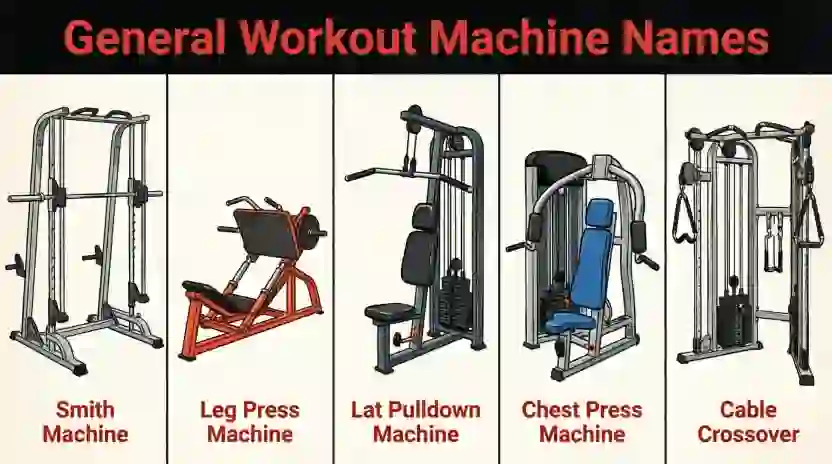
Workout machines help people build muscle, improve strength, burn calories, and support overall fitness. If you exercise at home or in a commercial gym, knowing the names of workout machines makes it easier to choose the right equipment for your goals.
This guide covers popular gym machine names, cardio equipment, strength-training machines, leg machines, upper-body machines, and home workout equipment. You will also learn what each machine does and which muscles it targets.
Common Workout Machine Names
These are some of the most popular workout machines you will find in gyms and fitness centers.
- Treadmill: Used for walking, jogging, and running.
- Stationary Bike: Provides indoor cycling for cardio fitness.
- Elliptical Machine: Offers low-impact cardio exercise for the upper and lower body.
- Rowing Machine: Simulates rowing and works the legs, back, arms, and core.
- Stair Climber: Mimics climbing stairs and challenges the legs and glutes.
- Leg Press Machine: Trains the quadriceps, glutes, and other leg muscles.
- Lat Pulldown Machine: Targets the back muscles, especially the latissimus dorsi.
- Chest Press Machine: Strengthens the chest, shoulders, and triceps.
- Shoulder Press Machine: Targets the shoulders and triceps.
- Cable Machine: Uses adjustable pulleys for many strength exercises.
- Smith Machine: Guides a barbell along fixed vertical or angled rails.
- Pec Deck Machine: Trains the chest through a fly movement.
- Leg Curl Machine: Targets the hamstrings.
- Leg Extension Machine: Targets the quadriceps.
- Ab Crunch Machine: Adds resistance to abdominal exercises.
Cardio Workout Machine Names
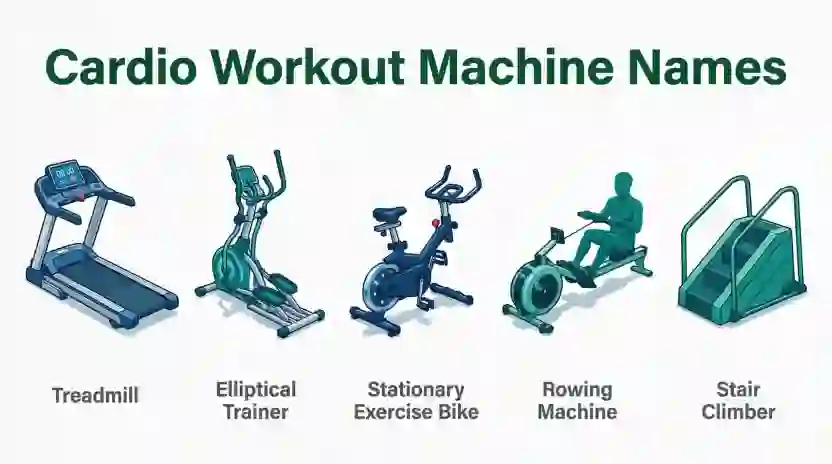
Cardio machines help improve heart and lung fitness. They can also support calorie burning and endurance training.
1. Treadmill
<AsyncImage query=”gym treadmill cardio exercise machine” aspectRatio=”16:9″ width=”100%” />
A treadmill has a moving belt for walking, jogging, or running. Many models let users adjust speed and incline.
Main benefits: Cardiovascular fitness, walking practice, and running endurance.
2. Stationary Exercise Bike
<AsyncImage query=”stationary upright exercise bike gym equipment” aspectRatio=”16:9″ width=”100%” />
An exercise bike provides an indoor cycling workout. Some models have upright seating, while others use a reclined seat.
Main benefits: Cardio fitness and lower-body endurance.
3. Elliptical Trainer
<AsyncImage query=”elliptical cross trainer machine gym” aspectRatio=”16:9″ width=”100%” />
An elliptical trainer uses foot pedals that follow an oval path. Moving handles on many models engage the arms.
Main benefits: Low-impact cardio and full-body movement.
4. Rowing Machine
<AsyncImage query=”indoor rowing ergometer machine gym” aspectRatio=”16:9″ width=”100%” />
A rowing machine uses a handle, sliding seat, and resistance system to simulate rowing.
Main benefits: Cardiovascular endurance and combined leg, back, arm, and core work.
5. Stair Climber
<AsyncImage query=”commercial gym stair climber stepmill machine” aspectRatio=”16:9″ width=”100%” />
A stair climber uses rotating steps or moving pedals to simulate stair climbing.
Main benefits: Lower-body endurance and cardiovascular conditioning.
6. Air Bike
<AsyncImage query=”fan resistance air bike exercise gym machine” aspectRatio=”16:9″ width=”100%” />
An air bike uses a fan for resistance and often has moving handles for both arms and legs.
Main benefits: Full-body cardio and interval training.
7. Recumbent Bike
<AsyncImage query=”recumbent exercise bike gym with backrest” aspectRatio=”16:9″ width=”100%” />
A recumbent bike has a supported seat with a backrest and pedals in front of the body.
Main benefits: Indoor cycling with a more reclined seating position.
8. Ski Ergometer
<AsyncImage query=”vertical ski ergometer fitness machine gym” aspectRatio=”16:9″ width=”100%” />
A ski ergometer uses pulling handles to imitate the arm action of cross-country skiing.
Main benefits: Cardio conditioning and upper-body endurance.
Upper-Body Workout Machine Names
Upper-body machines help train the chest, back, shoulders, arms, and related muscles.
- Chest Press Machine: Trains the chest, triceps, and front shoulders.
- Incline Chest Press Machine: Emphasizes the upper chest and front shoulders.
- Pec Deck Machine: Works the chest with a fly movement.
- Reverse Pec Deck: Targets the rear shoulders and upper back.
- Lat Pulldown Machine: Works the lats and supporting back muscles.
- Seated Row Machine: Trains the back, biceps, and rear shoulders.
- Assisted Pull-Up Machine: Provides support during pull-ups.
- Shoulder Press Machine: Strengthens the shoulders and triceps.
- Lateral Raise Machine: Targets the side deltoids.
- Biceps Curl Machine: Trains the biceps.
- Triceps Extension Machine: Focuses on the triceps.
- Cable Crossover Machine: Allows chest flyes and several cable exercises.
- Functional Trainer: Uses two adjustable cable columns for varied movements.
- Smith Machine: Supports guided barbell exercises such as presses and squats.
- Multi-Gym Machine: Combines several strength-training stations in one unit.
Lower-Body Workout Machine Names
Lower-body machines help strengthen the legs, hips, and glutes.
- Leg Press Machine: Trains the quadriceps, glutes, and hamstrings.
- Leg Extension Machine: Focuses on the quadriceps at the front of the thighs.
- Seated Leg Curl Machine: Targets the hamstrings.
- Lying Leg Curl Machine: Trains the hamstrings while lying face down.
- Standing Leg Curl Machine: Works one hamstring at a time.
- Hip Abductor Machine: Trains the muscles on the outer hips.
- Hip Adductor Machine: Targets the inner-thigh muscles.
- Glute Kickback Machine: Focuses on hip extension and the glutes.
- Hack Squat Machine: Trains the quadriceps and glutes.
- Smith Machine: Can be used for guided squats and lunges.
- Calf Raise Machine: Targets the calf muscles.
- Hip Thrust Machine: Trains the glutes through hip extension.
- Belt Squat Machine: Loads the legs while placing resistance through a belt around the hips.
- Pendulum Squat Machine: Provides a guided squat movement.
- Seated Calf Raise Machine: Emphasizes the soleus muscle in the calf.
Core and Ab Workout Machine Names
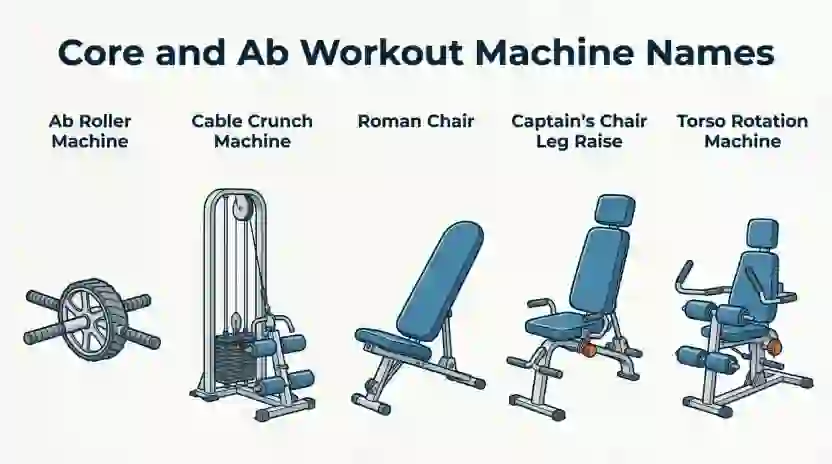
Core machines and stations help train the abdominal muscles and other muscles that stabilize the trunk.
- Ab Crunch Machine: Adds resistance to abdominal crunches.
- Captain’s Chair: Supports knee raises and leg raises.
- Roman Chair: Often used for back extensions and some core exercises.
- Ab Coaster: Guides the knees through a curved abdominal movement.
- Cable Machine: Can be used for cable crunches and woodchops.
- Rotary Torso Machine: Trains controlled trunk rotation.
- Back Extension Machine: Strengthens the lower-back muscles and other spinal extensors.
- Decline Ab Bench: Supports decline sit-ups and crunches.
- Vertical Knee Raise Station: Provides support for knee raises.
- Roman Chair Bench: Offers support for back extensions and selected bodyweight movements.
Cable and Functional Training Machine Names
Cable machines are versatile because users can change the handle, pulley height, and resistance.
- Cable Crossover: Commonly used for chest flyes.
- Dual Adjustable Pulley: Allows cable exercises from different angles.
- Functional Trainer: Supports movements for the whole body.
- Lat Pulldown Station: Provides a high-pulley pulling movement.
- Low Row Station: Supports horizontal pulling exercises.
- Cable Tower: A single-column pulley station.
- Smith Machine: Uses a guided bar for controlled barbell movements.
- Multi-Station Gym: Combines several cable and strength stations.
- Cable Triceps Pushdown Station: Uses a high pulley to train the triceps.
- Cable Biceps Curl Station: Uses a low pulley for curls.
- Cable Woodchop Station: Provides rotational resistance for core training.
- Cable Pull-Through Station: Supports a hip-hinge exercise targeting the glutes and hamstrings.
Home Workout Machine Names
Home workout machines can save space and make exercise more convenient.
- Foldable Treadmill: A treadmill designed to fold for storage.
- Compact Exercise Bike: A smaller indoor cycling machine.
- Under-Desk Pedal Exerciser: A compact device for light pedaling while seated.
- Folding Rowing Machine: A rowing machine designed for easier storage.
- Compact Elliptical: A smaller elliptical trainer for home use.
- Adjustable Weight Bench: Supports presses, rows, and other free-weight exercises.
- Home Multi-Gym: Combines several resistance exercises in one frame.
- Compact Cable Machine: Provides cable resistance for multiple exercises.
- Power Rack: A frame used for barbell exercises with safety supports.
- Smith Machine Home Gym: A guided-bar strength station.
- Vibration Plate: A platform that vibrates during standing or exercise positions.
- Mini Stepper: A compact device for stepping movements.
- Air Bike: A fan-resistance bike for home cardio.
- Walking Pad: A compact walking treadmill, often designed for small spaces.
- Adjustable Dumbbells: Not a machine, but a space-saving strength-training option.
Gym Machine Names for Beginners
If you are new to the gym, start with machines that have clear instructions and adjustable settings.
- Treadmill: Start with comfortable walking.
- Stationary Bike: Adjust the seat and begin with light resistance.
- Chest Press Machine: Learn controlled pressing with a manageable load.
- Lat Pulldown Machine: Practice pulling the bar toward the upper chest.
- Seated Row Machine: Keep the torso stable while pulling the handles.
- Leg Press Machine: Use a comfortable range of motion without locking the knees.
- Leg Curl Machine: Move the weight slowly to train the hamstrings.
- Leg Extension Machine: Use controlled movement and a comfortable knee range.
- Cable Machine: Begin with light resistance and simple exercises.
- Ab Crunch Machine: Avoid pulling with the arms or using momentum.
Ask gym staff to show you how to adjust each machine. Stop if an exercise causes sharp pain, and choose a lighter load if you cannot maintain good control.
Workout Machine Names and the Muscles They Target
Here is a quick guide to common machines and their primary training areas.
- Treadmill: Cardiovascular system and lower-body muscles.
- Stationary Bike: Quadriceps, glutes, and calf muscles.
- Elliptical Trainer: Legs and, on models with moving handles, the arms.
- Rowing Machine: Legs, back, arms, and core.
- Chest Press: Chest, triceps, and front shoulders.
- Lat Pulldown: Lats and other back muscles.
- Seated Row: Mid-back, lats, and biceps.
- Shoulder Press: Shoulders and triceps.
- Leg Press: Quadriceps and glutes.
- Leg Extension: Quadriceps.
- Leg Curl: Hamstrings.
- Hip Abductor: Outer-hip muscles.
- Hip Adductor: Inner-thigh muscles.
- Calf Raise: Calf muscles.
- Ab Crunch: Abdominal muscles.
- Back Extension: Spinal extensors and supporting trunk muscles.
A machine usually trains more than one muscle, so these are the primary areas rather than the only muscles involved.
How to Choose the Right Workout Machine
The best machine depends on your fitness goals, available space, experience, and comfort.
- For cardio fitness: Consider a treadmill, stationary bike, rowing machine, or elliptical.
- For leg strength: Consider the leg press, leg curl, and leg extension machines.
- For chest strength: Try a chest press or pec deck machine.
- For back strength: Consider a lat pulldown or seated row machine.
- For core training: Use an ab crunch machine, cable station, or bodyweight exercises.
- For a small home gym: Look at compact bikes, folding treadmills, adjustable dumbbells, or a multi-gym.
- For full-body workouts: A functional trainer or multi-station gym may offer several exercise options.
Before buying equipment, check its dimensions, weight capacity, adjustment options, maintenance requirements, and available warranty.
Frequently Asked Questions About Workout Machine Names
1. What are the most common workout machine names?
Common machines include the treadmill, stationary bike, elliptical trainer, rowing machine, leg press, chest press, lat pulldown, seated row, leg curl, and cable machine.
2. What machines are used for cardio at the gym?
Popular cardio machines include treadmills, exercise bikes, ellipticals, rowing machines, stair climbers, air bikes, and ski ergometers.
3. What gym machines work the whole body?
Rowing machines, air bikes, and some functional trainers can involve both the upper and lower body. Multi-gym stations also offer several exercises, although no single machine trains every muscle equally.
4. Which workout machines are good for beginners?
Treadmills, stationary bikes, chest press machines, lat pulldown machines, seated row machines, and leg press machines can be useful starting points when adjusted correctly.
5. What machines are used for leg workouts?
Common leg machines include the leg press, leg extension, leg curl, hack squat, hip abductor, hip adductor, calf raise, and glute kickback machines.
6. What is the difference between a Smith machine and a cable machine?
A Smith machine guides a barbell along fixed rails. A cable machine uses pulleys and cables to provide resistance from different angles.
7. Which machines are best for a home gym?
The right options depend on space and budget. Compact exercise bikes, folding treadmills, rowing machines, adjustable dumbbells, and multi-gyms are common choices.
Conclusion
Knowing workout machine names helps you understand gym equipment and choose exercises that match your goals. From cardio machines like treadmills and ellipticals to strength equipment like chest presses, leg presses, and cable stations, each machine offers different benefits.
Start with equipment that fits your experience and fitness needs. Learn the correct setup, use controlled movements, and increase resistance gradually as your strength and confidence improve.
Read more about!
- 250+ Uncommon Strong Boy Names With Powerful Meanings
- 100+ Mexican Last Names Starting With M
- 200+ Ice-Related Names: Cool, Unique, and Winter-Inspired Ideas

I’m Noah Wilson, a name enthusiast and writer at NamesProx. I enjoy researching and sharing creative, meaningful, and unique name ideas, from baby and pet names to character, fantasy, cultural, and business names. My goal is to make finding the perfect name simple, enjoyable, and useful for everyone.