Ukrainian male names combine Slavic heritage, Christian tradition, European influences, and distinctive Ukrainian forms. Names such as Bohdan, Taras, Dmytro, Mykola, Oleksandr, Volodymyr, Yaroslav, and Sviatoslav have deep cultural roots and remain recognizable Ukrainian choices. Ukrainian naming also includes names that came through Greek, Latin, Hebrew, and other languages and became established in Ukrainian usage.
If you need a Ukrainian boy name for a baby, character, story, game, or family project, this guide gives you many options. It also explains meanings, origins, pronunciation, and naming traditions.
Popular Ukrainian Male Names
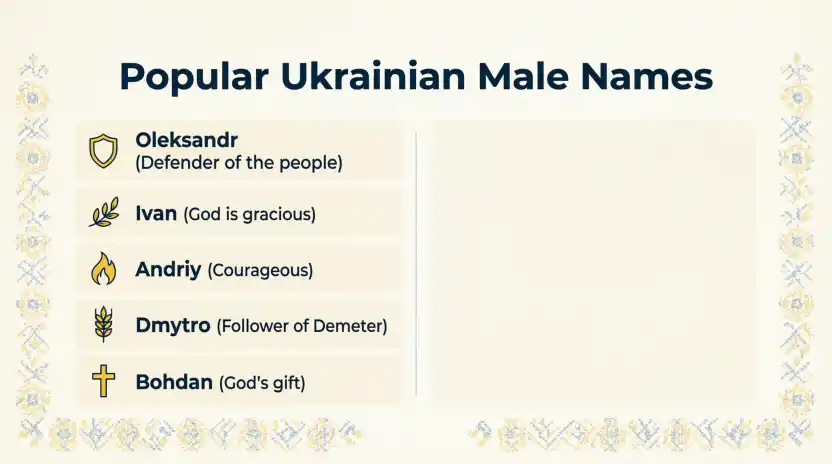
These names are familiar across Ukrainian naming traditions. Some have Slavic roots, while others entered Ukrainian through Christian and European naming traditions.
1. Andriy
Ukrainian: Андрій
Meaning: Manly or brave
Origin: Greek
Pronunciation: an-DREEY
Andriy is the Ukrainian form of Andrew. It is a well-established male name in Ukrainian usage.
2. Bohdan
Ukrainian: Богдан
Meaning: Given by God or gift from God
Origin: Slavic
Pronunciation: boh-DAHN
Bohdan comes from Slavic elements meaning “God” and “given.” It is one of the clearest examples of a native Slavic name with a religious meaning.
3. Dmytro
Ukrainian: Дмитро
Meaning: Devoted to Demeter
Origin: Greek
Pronunciation: DMY-tro
Dmytro is the Ukrainian form of Demetrius. It is a classic Ukrainian male name.
4. Ivan
Ukrainian: Іван
Meaning: God is gracious
Origin: Hebrew, through Christian traditions
Pronunciation: ee-VAHN
Ivan is a long-established name across Eastern Europe and has a strong place in Ukrainian naming history.
5. Mykola
Ukrainian: Микола
Meaning: Victory of the people
Origin: Greek
Pronunciation: my-KO-la
Mykola is the Ukrainian form related to Nicholas. The Greek name Nikolaos combines elements associated with “victory” and “people.”
6. Oleksandr
Ukrainian: Олександр
Meaning: Defender of people
Origin: Greek
Pronunciation: oh-lek-SAN-dr
Oleksandr is the Ukrainian form of Alexander. Its Greek roots are traditionally connected with defending or protecting people.
7. Taras
Ukrainian: Тарас
Meaning: Traditionally associated with Taras/Tarentum; the exact ancient etymology is debated
Origin: Greek
Pronunciation: ta-RAHS
Taras is strongly associated with Ukrainian culture because of the famous Ukrainian poet and artist Taras Shevchenko.
8. Volodymyr
Ukrainian: Володимир
Meaning: Commonly interpreted through Slavic elements related to rule and peace/greatness
Origin: Slavic
Pronunciation: vo-lo-DY-myr
Volodymyr is the Ukrainian form of Vladimir and has a long historical connection with Kyivan Rus.
Traditional Ukrainian Male Names
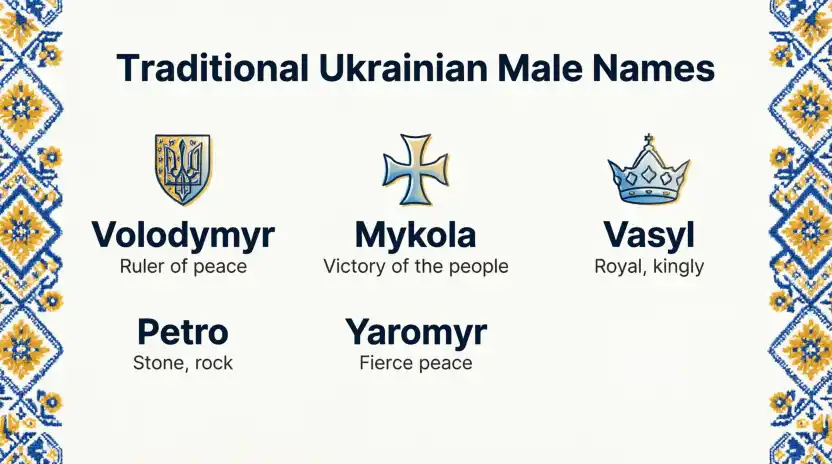
Traditional names can give a child or character a strong connection to Ukrainian language and history.
9. Vasyl
Ukrainian: Василь
Origin: Greek
Related name: Basil
10. Petro
Ukrainian: Петро
Meaning: Rock or stone
Origin: Greek
11. Pavlo
Ukrainian: Павло
Meaning: Small or humble
Origin: Latin
12. Stepan
Ukrainian: Степан
Meaning: Crown or wreath
Origin: Greek
13. Yuriy
Ukrainian: Юрій
Meaning: Farmer or earth-worker
Origin: Greek
14. Roman
Ukrainian: Роман
Meaning: Roman or citizen of Rome
Origin: Latin
15. Oleksii
Ukrainian: Олексій
Meaning: Defender or helper
Origin: Greek
16. Ihor
Ukrainian: Ігор
Meaning: Traditionally connected with the Old Norse name Ingvar
Origin: Norse, through East Slavic usage
17. Yosyp
Ukrainian: Йосип
Meaning: He will add
Origin: Hebrew
18. Yakiv
Ukrainian: Яків
Meaning: Traditionally linked with Jacob
Origin: Hebrew
19. Hryhoriy
Ukrainian: Григорій
Meaning: Watchful or vigilant
Origin: Greek
20. Artem
Ukrainian: Артем
Origin: Greek
Related names: Artemius, Artemios
Strong Ukrainian Male Names
Some names have meanings or historical associations that can give them a bold and memorable feel.
21. Yaroslav
Ukrainian: Ярослав
Meaning: Often interpreted from Slavic elements connected with fierceness or strength and glory
Origin: Slavic
Yaroslav is an old Slavic name and is associated with Yaroslav the Wise, the medieval ruler of Kyivan Rus.
22. Sviatoslav
Ukrainian: Святослав
Meaning: Sacred glory or holy glory
Origin: Slavic
The name combines Slavic elements associated with holiness and glory. It was also borne by a 10th-century ruler of Kyivan Rus.
23. Vladyslav
Ukrainian: Владислав
Meaning: Rule and glory
Origin: Slavic
24. Vsevolod
Ukrainian: Всеволод
Meaning: Traditionally interpreted as “rule all” or “one who rules all”
Origin: Slavic
25. Myroslav
Ukrainian: Мирослав
Meaning: Peace and glory
Origin: Slavic
26. Rostyslav
Ukrainian: Ростислав
Meaning: Growth and glory
Origin: Slavic
27. Boryslav
Ukrainian: Борислав
Meaning: Commonly interpreted through Slavic elements connected with battle and glory
Origin: Slavic
28. Bronislav
Ukrainian: Броніслав
Meaning: Commonly interpreted through Slavic elements associated with protection and glory
Origin: Slavic
29. Stanislav
Ukrainian: Станіслав
Meaning: Becoming famous or established in glory
Origin: Slavic
30. Vyacheslav
Ukrainian: В’ячеслав
Meaning: Greater glory
Origin: Slavic
Unique Ukrainian Male Names
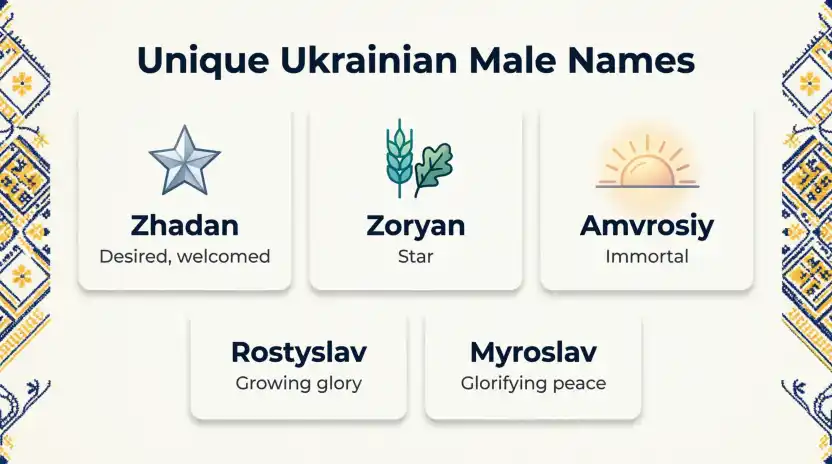
If you want something less familiar, these names can offer a more distinctive Ukrainian feel.
31. Ostap
Ukrainian: Остап
Origin: Greek
Related name: Eustathius
32. Orest
Ukrainian: Орест
Meaning: Mountain-dweller
Origin: Greek
33. Nazar
Ukrainian: Назар
Origin: Hebrew/Christian tradition
34. Marko
Ukrainian: Марко
Meaning: Traditionally associated with Mars
Origin: Latin
35. Lev
Ukrainian: Лев
Meaning: Lion
Origin: Greek/Latin naming tradition
36. Tymofii
Ukrainian: Тимофій
Meaning: Honoring God
Origin: Greek
37. Yevhen
Ukrainian: Євген
Meaning: Well-born or noble
Origin: Greek
Yevhen is the Ukrainian form of Eugene.
38. Kyrylo
Ukrainian: Кирило
Meaning: Lordly or masterful
Origin: Greek
39. Maksym
Ukrainian: Максим
Meaning: Greatest
Origin: Latin
40. Valentyn
Ukrainian: Валентин
Meaning: Strong or healthy
Origin: Latin
Ancient Slavic Ukrainian Male Names
Old Slavic names often use elements connected with concepts such as glory, peace, strength, rule, and protection.
41. Dobromyr
Ukrainian: Добромир
Meaning: Good and peaceful
Origin: Slavic
42. Bohuslav
Ukrainian: Богуслав
Meaning: God and glory
Origin: Slavic
43. Volodyslav
Ukrainian: Володислав
Meaning: Rule and glory
Origin: Slavic
44. Miloslav
Ukrainian: Милослав
Meaning: Gracious or dear glory
Origin: Slavic
45. Radomyr
Ukrainian: Радомир
Meaning: Joy and peace
Origin: Slavic
46. Dragomyr
Ukrainian: Драгомир
Meaning: Precious or dear peace
Origin: Slavic
47. Yaromyr
Ukrainian: Яромир
Meaning: A name combining Slavic elements associated with vigor and peace
Origin: Slavic
48. Vsevolod
Ukrainian: Всеволод
Meaning: Traditionally associated with universal rule
Origin: Slavic
49. Sviatopolk
Ukrainian: Святополк
Meaning: Holy or sacred people
Origin: Slavic
50. Yaropolk
Ukrainian: Ярополк
Meaning: A traditional Slavic compound name
Origin: Slavic
Ukrainian Male Names With Beautiful Meanings
A name can feel special because of its sound, history, or meaning. These choices have especially clear or memorable meanings.
51. Bohdan
“Gift from God.”
52. Oleksandr
“Defender of people.”
53. Mykola
“Victory of the people.”
54. Volodymyr
Associated with rule, peace, and greatness.
55. Yaroslav
Associated with glory and a strong Slavic element.
56. Sviatoslav
“Sacred glory” or “holy glory.”
57. Myroslav
Associated with peace and glory.
58. Vladyslav
Associated with rule and glory.
59. Rostyslav
Associated with growth and glory.
60. Stanislav
Associated with becoming or standing in glory.
Ukrainian Boy Names With Christian Roots
Christianity had a major influence on Ukrainian personal naming. As a result, many Ukrainian male names have Greek, Hebrew, or Latin origins but developed distinctive Ukrainian forms.
61. Andriy
Ukrainian form of Andrew.
62. Dmytro
Ukrainian form of Demetrius.
63. Ivan
Ukrainian form related to John.
64. Mykola
Ukrainian form of Nicholas.
65. Petro
Ukrainian form of Peter.
66. Pavlo
Ukrainian form of Paul.
67. Yosyp
Ukrainian form of Joseph.
68. Yakiv
Ukrainian form of Jacob.
69. Stepan
Ukrainian form of Stephen.
70. Oleksii
Ukrainian form related to Alexis/Alexius.
These forms show why a Ukrainian name may look quite different from its English equivalent even when the names share the same historical root.
More Ukrainian Male Names to Consider
Here are additional choices for parents, writers, gamers, and character creators.
71. Anatoliy
A Ukrainian form of Anatolius.
72. Anton
A Ukrainian male form related to Anthony.
73. Arkadii
A Ukrainian form of Arcadius.
74. Arsen
A Ukrainian male name of Greek origin.
75. Arsenii
A Ukrainian form related to Arsenius.
76. Artur
A Ukrainian form of Arthur.
77. Boris
A traditional Slavic name with a long history in Eastern Europe.
78. Viktor
A Latin name meaning “victor” or “conqueror.”
79. Valerii
A Ukrainian form related to Valerius.
80. Denys
A Ukrainian form related to Dionysius.
81. Eduard
A Ukrainian-used form of Edward.
82. Fedir
A Ukrainian form of Theodore.
83. Hlib
A traditional East Slavic male name.
84. Leonid
A Greek-derived name associated with a lion.
85. Matvii
A Ukrainian form of Matthew.
86. Oleksiy
A common transliteration variant of Oleksii.
87. Serhii
A Ukrainian form related to Sergius.
88. Symon
A Ukrainian form of Simon.
89. Tymur
A name used in Ukrainian naming alongside broader Eurasian traditions.
90. Vsevolod
An old Slavic name associated with rule.
91. Yevstakhii
A Ukrainian form of Eustachius.
92. Zakhar
A Ukrainian-used form related to Zechariah.
93. Illia
Ukrainian: Ілля
A Ukrainian form of Elijah.
94. Mark
Ukrainian: Марк
A short and internationally recognizable choice.
95. Daniel
Ukrainian: Данило
A Ukrainian form related to Daniel.
96. Roman
Ukrainian: Роман
A traditional Latin-derived choice used in Ukraine.
97. Ihnat
Ukrainian: Ігнат
A Ukrainian form related to Ignatius.
98. Kornel
Ukrainian: Корнель
A Ukrainian-used form related to Cornelius.
99. Demian
Ukrainian: Дем’ян
A Ukrainian form related to Damian.
100. Adrian
Ukrainian: Адріан
A Latin-derived name connected historically with Hadrianus.
How Ukrainian Male Names Are Used
A Ukrainian full name can contain more than just a given name and surname. A traditional naming pattern may include a personal name, patronymic, and family name.
Understanding the Patronymic
A patronymic is formed from the father’s given name. For men, Ukrainian patronymics commonly use endings such as -ovych or -yovych.
For example:
- Dmytro Oleksandrovych Petrenko
- Andriy Mykolaiovych
- Taras Ivanovych
The exact form depends on the father’s name and Ukrainian grammatical patterns.
Why This Matters
Understanding patronymics helps when reading Ukrainian historical records, creating realistic fictional characters, or learning how formal Ukrainian names are structured.
A Ukrainian male name should not automatically be treated as a surname or middle name. The parts of the full name can have different linguistic functions.
Ukrainian vs. Russian Name Forms
Some names exist in both Ukrainian and Russian, but their forms can differ.
For example:
- Ukrainian Dmytro corresponds to Russian Dmitry.
- Ukrainian Mykola corresponds to Russian Nikolai.
- Ukrainian Oleksandr corresponds to Russian Aleksandr.
- Ukrainian Volodymyr corresponds to Russian Vladimir.
- Ukrainian Yevhen corresponds to Russian Yevgeny.
These differences are important when choosing a specifically Ukrainian form rather than a broader East Slavic equivalent. Ukrainian naming references list many of these distinct forms separately.
How to Choose the Right Ukrainian Male Name
The best name depends on what you want the name to communicate.
For a Traditional Feel
Consider:
- Taras
- Mykola
- Petro
- Vasyl
- Dmytro
- Andriy
- Ivan
- Stepan
These names have long-established Ukrainian usage.
For a Strong Slavic Feel
Consider:
- Yaroslav
- Sviatoslav
- Volodymyr
- Vladyslav
- Myroslav
- Rostyslav
- Vsevolod
These names contain recognizable Slavic elements and often connect to ideas such as glory, peace, or rule.
For a Short and Simple Name
Consider:
- Lev
- Mark
- Ihor
- Nazar
- Roman
- Anton
- Ivan
These names are easy to remember and work well in both Ukrainian and international settings.
For a Historical or Literary Feel
Consider:
- Taras
- Bohdan
- Volodymyr
- Yaroslav
- Sviatoslav
- Mykola
Several of these names are connected with important figures in Ukrainian history and culture. For example, Taras is especially associated with Taras Shevchenko.
How to Pronounce Ukrainian Male Names
Ukrainian transliteration can make familiar names look different to English readers.
A few examples include:
- Andriy — an-DREEY
- Bohdan — boh-DAHN
- Dmytro — DMY-tro
- Mykola — my-KO-la
- Oleksandr — oh-lek-SAN-dr
- Taras — ta-RAHS
- Volodymyr — vo-lo-DY-myr
- Yaroslav — ya-ro-SLAV
Pronunciation can vary slightly depending on speaker, region, and the system used for transliteration.
FAQs About Ukrainian Male Names
1. What are some popular Ukrainian male names?
Popular and well-known Ukrainian male names include Oleksandr, Andriy, Dmytro, Mykola, Bohdan, Ivan, Taras, Volodymyr, Yaroslav, and Vasyl.
2. What is a traditional Ukrainian boy name?
Taras, Bohdan, Mykola, Dmytro, Petro, Vasyl, Andriy, and Volodymyr are strong traditional choices with established Ukrainian usage.
3. What Ukrainian male name means “gift from God”?
Bohdan is a Slavic name formed from elements meaning “God” and “given,” giving it the sense “given by God” or “God’s gift.”
4. What does the Ukrainian name Oleksandr mean?
Oleksandr is the Ukrainian form of Alexander. Its Greek roots are traditionally interpreted as relating to a defender or protector of people.
5. What does Mykola mean?
Mykola is the Ukrainian form related to Nicholas. Its Greek roots are traditionally explained through words associated with victory and people.
6. Is Taras a Ukrainian name?
Yes. Taras is strongly established in Ukrainian usage. It is also culturally significant because of Ukrainian poet and artist Taras Shevchenko.
7. What is the Ukrainian form of Alexander?
The Ukrainian form is Oleksandr (Олександр).
8. What is the Ukrainian form of Vladimir?
The Ukrainian form is Volodymyr (Володимир).
9. What is the Ukrainian form of Nicholas?
The Ukrainian form is Mykola (Микола).
10. Do Ukrainian names use patronymics?
Ukrainian naming traditions include patronymics, which are derived from the father’s given name. Male patronymics commonly use endings such as -ovych and -yovych.
11. What Ukrainian male names have Slavic origins?
Examples include Bohdan, Volodymyr, Yaroslav, Sviatoslav, Vladyslav, Myroslav, Rostyslav, and Vsevolod.
12. Are Ukrainian and Russian male names the same?
Not always. Some names are shared across the region, while others have distinct Ukrainian forms. For example, Dmytro, Mykola, Oleksandr, and Volodymyr are Ukrainian forms that differ from common Russian equivalents.
Conclusion
Ukrainian male names offer a wide mix of Slavic, Greek, Latin, Hebrew, and Christian traditions. Names such as Bohdan, Taras, Yaroslav, Sviatoslav, Volodymyr, Mykola, Oleksandr, and Dmytro can provide different cultural and linguistic connections.
If you want a distinctly Ukrainian sound, pay attention to the Ukrainian spelling and form, not only the English equivalent. You can also consider the name’s meaning, pronunciation, historical associations, and how it fits with the family surname.
For a traditional choice, names like Taras, Mykola, Bohdan, and Dmytro are useful starting points. For an older Slavic feel, Yaroslav, Sviatoslav, Myroslav, and Vladyslav offer another direction.
Read more about!
- 150+ Girl Dog Names That Start With M: Cute, and Pretty Ideas
- 150+ Boy Names C: Cute, Classic, and Strong C Names
- 150+ Venezuelan Names: Traditional, Modern, and Unique Ideas

I’m Noah Wilson, a name enthusiast and writer at NamesProx. I enjoy researching and sharing creative, meaningful, and unique name ideas, from baby and pet names to character, fantasy, cultural, and business names. My goal is to make finding the perfect name simple, enjoyable, and useful for everyone.