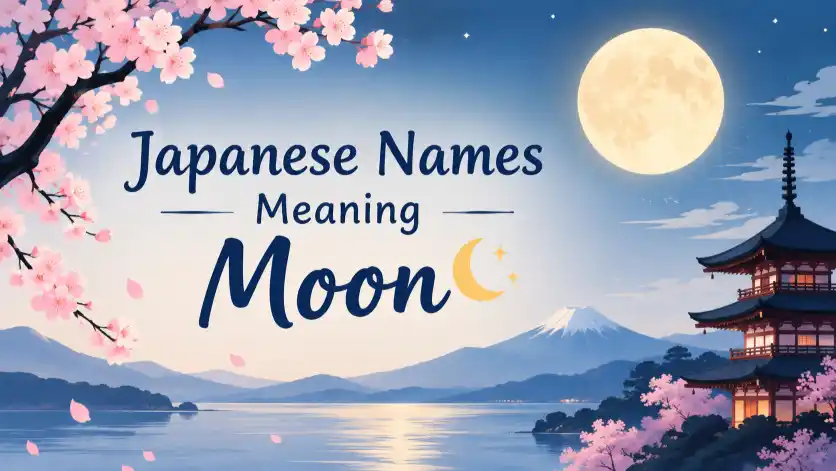
Japanese names meaning moon are beautiful choices for parents who love nature, nighttime, and celestial themes. The moon has a special place in Japanese poetry, art, and traditional stories. It often symbolizes beauty, calmness, mystery, and the changing seasons.
Japanese names can have different meanings depending on the kanji used to write them. The character 月 means “moon” or “month,” and it appears in several names and poetic expressions. Some names below use this character directly, while others are associated with moonlight, the night sky, or lunar mythology.
This guide explores Japanese moon names for boys, girls, and unisex use, along with pronunciation notes and tips for choosing an authentic name.
Japanese Names That Literally Mean Moon
These names use the Japanese character 月 (tsuki or getsu/gatsu in different compounds), which means “moon” or “month.” The exact reading of a name can depend on its kanji and naming tradition.
- Tsuki (月) — Moon.
- Mitsuki (美月) — Often interpreted as “beautiful moon.”
- Hazuki (葉月) — Traditionally the name of the eighth month in the old Japanese calendar; not literally “moon leaf” in every context.
- Satsuki (皐月) — Traditionally associated with the fifth month in the old Japanese calendar.
- Katsuki (月希 or other spellings) — A possible modern name reading; meaning depends on the chosen kanji.
- Runa (月 or other spellings) — Sometimes written with moon-related characters, but the meaning depends on the specific name spelling.
- Mizuki (美月) — Commonly interpreted as “beautiful moon” with these kanji.
- Yuzuki (優月 or 柚月) — A name whose meaning varies by kanji; some spellings include 月.
- Kozuki (小月 or other spellings) — Can be written with a character meaning “moon,” depending on the chosen form.
- Akizuki (秋月) — “Autumn moon” when written with these characters; also used as a surname.
Japanese Girl Names Meaning Moon
These names are often chosen for their gentle sound and associations with beauty, moonlight, or the night sky. Some contain the character for moon, while others have broader celestial associations.
- Mitsuki (美月) — Beautiful moon.
- Mizuki (美月) — Beautiful moon with this kanji spelling.
- Yuzuki (優月) — Often interpreted as “gentle moon” with these characters.
- Kaguya (かぐや) — Famous from the Japanese folktale The Tale of the Bamboo Cutter, which features a princess associated with the Moon.
- Tsukiko (月子) — Moon child.
- Tsukina (月菜 or other spellings) — A modern name that can include the moon character; the full meaning depends on the kanji.
- Tsukimi (月見) — Moon viewing; more commonly a word or cultural expression than a typical given name.
- Runa (ルナ) — A Japanese rendering of “Luna,” the Latin word for moon.
- Luna (ルナ) — A borrowed name meaning “moon” in Latin.
- Sena (星奈 or other spellings) — A modern name; some spellings can include star-related characters.
- Hizuki (日月 or other spellings) — A possible name reading whose meaning depends on the kanji.
- Hazuki (葉月) — A traditional calendar name often used as a given name.
- Satsuki (皐月) — A traditional month name used as a given name.
- Kozue (梢) — “Tree top” or “treetop”; a nature-inspired name rather than a literal moon name.
- Runa (月) — A possible creative spelling using the moon character, but this reading is not automatic and should be verified before use.
Japanese Boy Names Meaning Moon
Japanese boy names with moon-related meanings can feel calm, distinctive, and connected to nature. Many modern Japanese names allow several possible kanji spellings.
- Mitsuki (光月 or other spellings) — Can suggest light and moon when written with these characters.
- Yuzuki (悠月 or other spellings) — A possible masculine name containing the moon character.
- Katsuki (勝月 or other spellings) — A possible name spelling combining victory and moon.
- Ritsuki (律月 or other spellings) — A modern-style name that can include the moon character.
- Getsu (月) — A reading of the moon character in certain compounds; uncommon as a standalone given name.
- Tsukito (月人 or other spellings) — Can be interpreted as “moon person” with these characters; a distinctive name construction.
- Akito (明人 or other spellings) — May convey brightness or a bright person, depending on the kanji; not inherently a moon name.
- Haruki (春輝 or other spellings) — Often associated with spring and radiance when written with these characters.
- Kouki (光輝 or other spellings) — Can mean “radiant light” with these characters, though not specifically moon.
- Sora (空) — Sky; a celestial name rather than a literal moon name.
- Riku (陸) — Land; not a moon name, but a popular nature-related choice.
- Ren (蓮) — Lotus; not a literal moon name.
- Itsuki (樹 or other spellings) — Often associated with trees when written with 樹.
- Yukito (雪人 or other spellings) — Can suggest “snow person” with these characters; not inherently a moon name.
- Tsukasa (司 or other spellings) — A traditional name with several possible meanings; not automatically moon-related.
Japanese Unisex Names With Moon Meanings
Some Japanese names are used for more than one gender. Their meanings depend on the kanji selected by the family.
- Mitsuki (美月) — Beautiful moon.
- Mizuki (美月) — Beautiful moon.
- Yuzuki (優月) — Gentle moon with this spelling.
- Hazuki (葉月) — A traditional calendar name.
- Satsuki (皐月) — A traditional month name.
- Runa (ルナ) — Japanese rendering of the Latin name Luna.
- Tsuki (月) — Moon; more often a word or nickname than a conventional given name.
- Katsuki (月希 or other spellings) — A modern name that can include the moon character.
- Ritsuki (律月 or other spellings) — A possible name construction with the moon character.
- Yuki (雪 or other spellings) — Can mean “snow” with 雪; it does not automatically mean moon.
Japanese Names Meaning Moonlight

Moonlight-inspired names can evoke a quiet night, a glowing sky, or a soft celestial glow. Not all of these names literally mean “moonlight,” so check the kanji carefully.
- Tsukiko (月子) — Moon child.
- Mitsuki (美月) — Beautiful moon.
- Mizuki (美月) — Beautiful moon.
- Akari (明里 or other spellings) — Brightness or light, depending on the kanji.
- Hikari (光) — Light.
- Kouki (光輝) — Radiance or shining light with these characters.
- Raito (ライト) — A phonetic rendering of “light”; not a traditional moon-specific name.
- Getsumei (月明) — Moon brightness or moonlight as a compound expression; uncommon as a given name.
- Gekkou (月光) — Moonlight; more commonly a word than a personal name.
- Tsukiyo (月夜) — Moonlit night; a poetic expression and an uncommon personal-name choice.
Japanese Names Inspired by the Moon and Night Sky
If you like the moon but do not need the name to mean “moon” literally, these celestial and night-inspired options may appeal to you.
- Hoshi (星) — Star.
- Subaru (昴) — The Pleiades star cluster.
- Sora (空) — Sky.
- Hikaru (光) — Light or radiance.
- Akari (明かり or other spellings) — Light or brightness.
- Hotaru (蛍) — Firefly.
- Amaya (雨夜 or other spellings) — A possible name construction associated with rain and night, depending on the characters.
- Yoru (夜) — Night; more commonly a word than a conventional given name.
- Seira (星羅 or other spellings) — A possible name using star-related characters.
- Kira (きら or other spellings) — A name with different possible origins and spellings; sometimes used for a sparkling impression.
- Mikazuki (三日月) — Crescent moon; primarily a Japanese word and an uncommon given name.
- Mangetsu (満月) — Full moon; a common word, but unusual as a personal name.
- Shizuku (雫) — Droplet; a nature-inspired name rather than a moon name.
- Aoi (葵 or other spellings) — A name associated with hollyhock when written 葵.
- Nozomi (望) — Hope or wish; the character 望 can also appear in lunar-calendar contexts.
Japanese Moon Names From Folklore and Culture
The moon has an important place in Japanese storytelling and seasonal traditions.
- Kaguya-hime — The Moon Princess in The Tale of the Bamboo Cutter, one of Japan’s best-known folktales.
- Tsukuyomi (月読) — A Shinto moon deity. This is a mythological name rather than a common modern baby name.
- Tsukiko (月子) — “Moon child,” a name construction using the moon character.
- Mikazuki (三日月) — Crescent moon, often found in poetry and imagery.
- Mangetsu (満月) — Full moon, a word associated with the full lunar disk.
- Tsukimi (月見) — Moon viewing, a Japanese custom of appreciating the autumn moon.
- Otsukimi (お月見) — The traditional moon-viewing celebration, especially associated with autumn.
- Usagi (兎 or うさぎ) — Rabbit; connected to the rabbit often seen in Japanese moon folklore.
- Tsukuyomi-no-Mikoto — A formal name for the Shinto moon deity.
Short Japanese Moon Names
If you prefer a short, easy-to-remember name, these options are worth exploring.
- Tsuki (月) — Moon.
- Runa (ルナ) — Luna, meaning moon in Latin.
- Luna (ルナ) — Borrowed name meaning moon in Latin.
- Mitsuki (美月) — Beautiful moon.
- Mizuki (美月) — Beautiful moon.
- Yuzuki (優月) — Gentle moon with this spelling.
- Hikari (光) — Light.
- Akari (明里 or other spellings) — Brightness or light.
- Hoshi (星) — Star.
- Sora (空) — Sky.
How to Choose a Japanese Name Meaning Moon
Choosing a Japanese name requires more than finding a word that sounds beautiful. The written characters, pronunciation, and cultural use all matter.
- Check the kanji: The same pronunciation can have different meanings depending on the characters.
- Confirm the reading: Japanese kanji may have several readings, and a name’s reading is not always predictable.
- Separate names from ordinary words: Terms like Mikazuki, Mangetsu, and Tsukimi have clear lunar meanings but are not necessarily common personal names.
- Consider cultural context: A mythological name like Tsukuyomi carries a different feel from a modern name like Mitsuki.
- Ask a fluent speaker: If you plan to use the name for a child, confirm that the spelling and reading feel natural to Japanese speakers.
Frequently Asked Questions About Japanese Names Meaning Moon
1. What Japanese name means moon?
Tsuki (月) is the Japanese word for “moon.” It can be used creatively as a name, although it is more commonly encountered as a word or name element than as a conventional given name.
2. What Japanese girl name means beautiful moon?
Mitsuki (美月) and Mizuki (美月) can be interpreted as “beautiful moon” when written with the characters 美, meaning “beauty,” and 月, meaning “moon.”
3. What Japanese boy name means moon?
Tsukito (月人) is a possible name construction that can mean “moon person” with these characters. Names such as Mitsuki and Yuzuki can also be used for boys, depending on the family and chosen kanji.
4. What Japanese name means moon child?
Tsukiko (月子) can be interpreted as “moon child,” combining 月 (“moon”) and 子 (“child”).
5. What Japanese name means moonlight?
Gekkou (月光) is the Japanese word for “moonlight.” It is more commonly a vocabulary word than a standard given name. Names such as Hikari, meaning “light,” can offer a related feeling.
6. Is Mitsuki a Japanese name meaning moon?
Yes. When written 美月, Mitsuki can be interpreted as “beautiful moon.” However, Mitsuki can also be written with other kanji, which may change its meaning.
7. What is the Japanese moon goddess’s name?
Tsukuyomi, also called Tsukuyomi-no-Mikoto, is a Shinto deity associated with the moon. Tsukuyomi is a mythological name, not one of the most common modern given names.
8. What Japanese name means crescent moon?
Mikazuki (三日月) means “crescent moon.” It is primarily a Japanese word and a poetic name idea rather than a conventional common given name.
Conclusion
Japanese names meaning moon offer a beautiful connection to nature, poetry, and traditional stories. Names such as Tsuki, Mitsuki, Mizuki, and Tsukiko use the moon character directly, while Hikari and Akari evoke light and brightness. For a mythological choice, Tsukuyomi connects to Japanese Shinto tradition.
Before choosing a name, confirm the kanji, reading, and cultural meaning. This helps ensure that the name is not only beautiful but also appropriate and meaningful.
Read more about!
- Hard Names to Pronounce: 150+ Challenging and Unique Ideas
- Boy Names With Y: 200+ Unique, Cute, and Popular Ideas
- Common Greek Names: 200+ Popular Names for Boy and Girl

I’m Noah Wilson, a name enthusiast and writer at NamesProx. I enjoy researching and sharing creative, meaningful, and unique name ideas, from baby and pet names to character, fantasy, cultural, and business names. My goal is to make finding the perfect name simple, enjoyable, and useful for everyone.