If you are looking for common Scottish last names, you will find a mix of Gaelic, Scots, English, Norse, Norman, and place-based names. Some came from a person’s father, while others came from an occupation, landscape, nickname, or place.
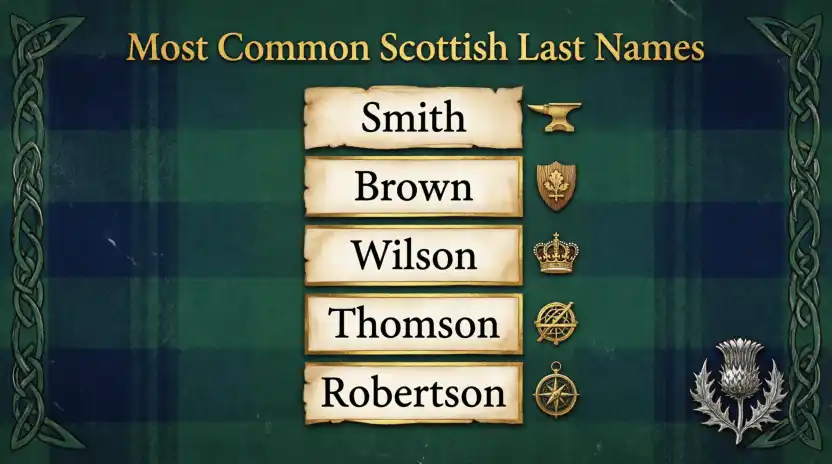
The latest National Records of Scotland data for 2025 lists Smith, Brown, Wilson, Thomson, Campbell, Stewart, Robertson, Anderson, Taylor, and Murray among the most frequently occurring surnames in Scotland’s birth, marriage, and death registers.
It is also important to remember that a common surname is not automatically a uniquely Scottish surname. Names such as Smith, Brown, Taylor, and Clark developed in several parts of Britain and beyond. Scottish surname history is a blend of many languages and cultures.
Most Common Scottish Last Names
The following names are drawn from the latest NRS list, with additional widely recognized Scottish surnames included for context. NRS counts surname occurrences in birth, marriage, and death registers, so its ranking is not a complete count of everyone currently living in Scotland.
1. Smith
Origin: Occupational
Meaning: A smith or metalworker.
Smith is the most frequently occurring surname in the NRS 2025 data. It has long been associated with the occupation of working metal and is found across Britain and many other English-speaking countries.
2. Brown
Origin: Nickname or descriptive surname
Meaning: Often associated with brown coloring, hair, complexion, or clothing.
Brown is one of the three most common surnames in Scotland in the NRS data. Its exact origin can vary between families.
3. Wilson
Origin: Patronymic
Meaning: Son of William.
The ending -son is a classic patronymic pattern. Wilson can be found throughout Britain, including Scotland.
4. Thomson
Origin: Patronymic
Meaning: Son of Thomas.
Thomson is a long-established Scottish surname. The spelling Thomson is particularly familiar in Scotland, while Thompson is also common elsewhere.
5. Campbell
Origin: Gaelic nickname
Traditional meaning: Commonly explained from Gaelic Caimbeul, traditionally interpreted as “crooked mouth.”
Campbell became strongly associated with a major Highland clan, but having the surname does not by itself prove descent from a particular Campbell family.
6. Stewart
Origin: Occupational
Meaning: Steward or household official.
The surname is also closely connected with the royal Stewart dynasty. Its history illustrates how an occupation could become a hereditary surname.
7. Robertson
Origin: Patronymic
Meaning: Son of Robert.
Robertson developed from the personal name Robert. It became especially established in parts of Scotland and is also associated with several historical families.
8. Anderson
Origin: Patronymic
Meaning: Son of Andrew.
Anderson is formed from Andrew with the common -son ending.
9. Taylor
Origin: Occupational
Meaning: Tailor.
The surname refers to a person whose occupation was making or repairing clothing. Taylor is not exclusive to Scotland, but it has a long history of use there.
10. Murray
Origin: Territorial
Meaning: Associated with Moray.
Scotland’s People identifies Murray as an example of a territorial surname connected with the lands of Moray.
More Common Scottish Surnames
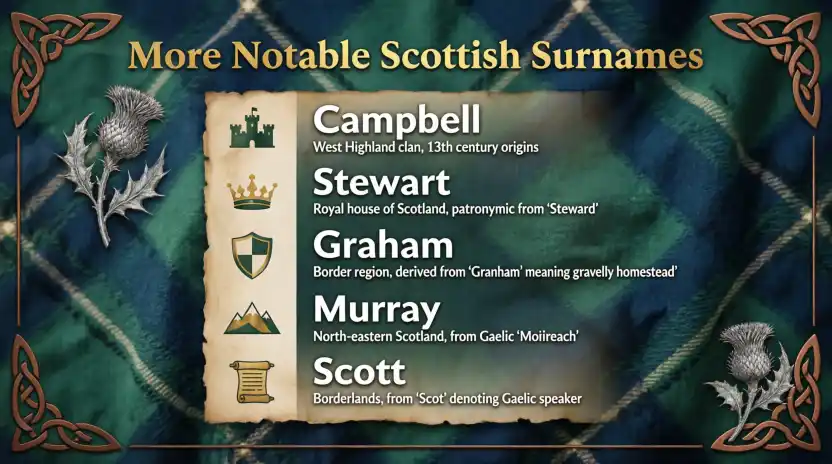
11. Scott
Origin: Regional or ethnic
Meaning: Traditionally associated with a person from Scotland or a Gaelic-speaking Scot.
Scott is one of the best-known surnames associated with Scotland, although the surname itself has also spread widely outside the country.
12. Reid
Origin: Descriptive nickname
Meaning: Traditionally linked with red or reddish coloring, especially hair or complexion.
13. Clark
Origin: Occupational
Meaning: Clerk or scholar.
The surname developed from a term for a cleric, clerk, or educated person.
14. Walker
Origin: Occupational
Meaning: A person who worked with cloth, traditionally associated with the process of fulling or finishing wool.
Scotland’s People lists Walker among Scottish occupational surnames.
15. Mitchell
Origin: Personal-name surname
Meaning: Derived from Michael or a related form.
Mitchell developed in different places and family lines, so its history is not identical for every bearer.
16. Young
Origin: Nickname
Meaning: Young or junior.
It could help distinguish a younger person from an older family member with the same personal name.
17. Ross
Origin: Territorial
Meaning: Connected with places called Ross.
Ross is an important Scottish territorial surname and is strongly associated with northern Scotland.
18. Morrison
Origin: Patronymic
Meaning: Son of Morris or Maurice.
The surname developed from a personal name rather than directly from a place or occupation.
19. Watson
Origin: Patronymic
Meaning: Son of Walter.
Watson is another example of the widespread -son surname pattern.
20. Paterson
Origin: Patronymic
Meaning: Son of Patrick.
Paterson is particularly familiar in Scotland and represents the Scottish use of personal names as family names.
Scottish Last Names With Gaelic Roots
Scottish surname history cannot be understood without Gaelic. Gaelic naming traditions were especially important in the Highlands and Islands.
Scotland’s People explains that Mac is a Gaelic prefix meaning “son.” It also notes that Mac surnames could appear as Mac, Mc, Mhic, or M’ in historical records.
MacDonald
Meaning: Son of Donald.
MacDonald comes from the Gaelic patronymic tradition and became associated with the powerful Clan Donald.
MacKenzie
Traditional origin: Gaelic surname associated with the personal name Coinneach.
MacKenzie is one of the well-known Highland surnames.
MacLean
Origin: Gaelic
MacLean is an old Scottish surname with strong Highland and Hebridean associations.
MacLeod
Origin: Gaelic/Norse-influenced Highland tradition
MacLeod is particularly associated with the Western Isles and the Isle of Skye.
MacKay
Origin: Gaelic
MacKay is strongly associated with northern Scotland, especially Sutherland and Caithness.
MacGregor
Origin: Gaelic
MacGregor is a historic Scottish surname associated with the Highlands.
MacArthur
Origin: Gaelic
MacArthur follows the familiar Mac + personal-name pattern.
MacIntyre
Origin: Gaelic
The surname is commonly connected with the Gaelic Mac an t-Saoir, traditionally understood as “son of the craftsman.”
How Scottish Last Names Were Formed
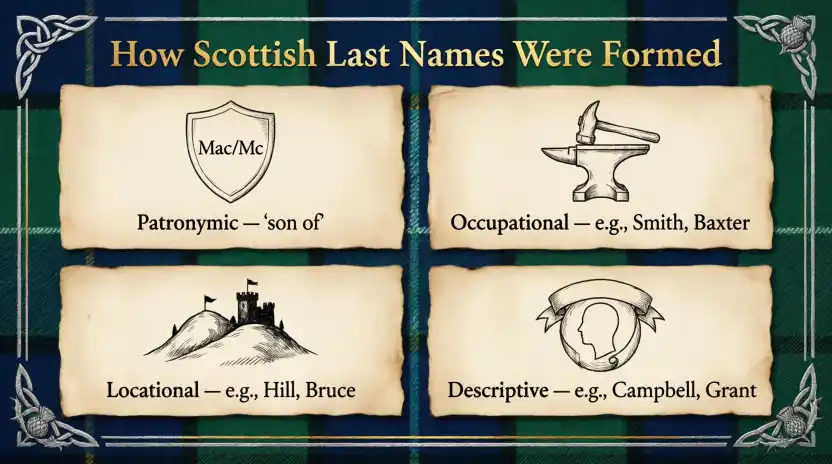
Scottish surnames did not all develop in the same way. Scotland’s People identifies several major sources, including occupations, locations, patronymics, Gaelic naming traditions, nicknames, and outside linguistic influences.
Patronymic Surnames
A patronymic surname originally identified someone through their father.
Examples include:
- Wilson — son of William
- Robertson — son of Robert
- Anderson — son of Andrew
- Watson — son of Walter
- Paterson — son of Patrick
- Thomson — son of Thomas
In earlier Scottish naming systems, the surname could change from one generation to another. This practice eventually became less common as hereditary surnames became fixed. It survived longer in some Highland, Island, and Northern Isles communities.
Occupational Surnames
Some surnames describe the work a person or ancestor did.
Examples include:
- Smith — metalworker
- Stewart — steward
- Taylor — tailor
- Clark — clerk
- Walker — cloth worker or fuller
- Mason — mason or stoneworker
- Baxter — baker
Scotland’s People specifically identifies Smith, Taylor, Mason, Stewart, Baxter, Walker, and other names as examples of occupational surname development.
Territorial Surnames
Some Scottish surnames came from places or lands.
Examples include:
- Murray — associated with Moray
- Ross — associated with Ross
- Gordon — associated with places named Gordon
- Hamilton — associated with Hamilton
- Douglas — associated with Douglas
Territorial surnames could arise when landowners were identified by their estates. Scotland’s People also notes that tenants could sometimes take or receive the name of a landlord without being close relatives.
Nickname and Descriptive Surnames
Some surnames began as descriptions of people.
Examples include:
- Brown — associated with brown coloring
- Reid — traditionally associated with red coloring
- Young — a younger person
- Little — a small or younger person
- White — associated with white or fair coloring
- Campbell — traditionally explained from a Gaelic nickname
The original meaning does not necessarily describe the appearance of every modern person who carries the surname.
Why Do So Many Scottish Surnames Begin With Mac or Mc?
Mac is a Gaelic word meaning “son.” A surname such as MacDonald therefore has a patronymic structure: Mac + Donald.
The spelling is not always consistent in historical records. The same family or even the same individual might appear as MacDonald in one record and McDonald in another.
Scotland’s People recommends checking both forms when researching historical records because spelling changed for many reasons, including clerical variation, phonetic spelling, and later anglicization.
Mac Does Not Automatically Mean Clan Descent
A surname beginning with Mac or Mc does not, by itself, prove that someone belongs to a particular clan.
Scottish surnames developed through different social and linguistic processes. Some names were adopted, translated, anglicized, or changed over time.
For genealogy, it is better to follow documented records than to assume ancestry from a surname alone.
Scottish Surname Spelling Variations
Historical Scottish records can contain several spellings of the same surname.
For example, researchers may encounter:
- MacDonald / McDonald
- MacKenzie / McKenzie
- MacLean / McLean
- Thomson / Thompson
- Paterson / Patterson
- Reid / Reed
- Stewart / Stuart
The spelling may have changed because of phonetic writing, transcription, migration, anglicization, or the preferences of individual record keepers. Scotland’s People specifically warns researchers that surname spelling can vary substantially in historical records.
Scottish Surnames and Clans
Clans are an important part of Scottish history, especially in the Highlands and Islands. However, surname and clan are not interchangeable terms.
A clan could include people who did not share the chief’s surname. Likewise, people with the same surname could belong to unrelated family lines.
For family-history research, a surname can provide a useful starting point, but records such as births, marriages, deaths, land documents, wills, and census material provide stronger evidence of a particular family connection.
Are These Names Really Scottish?
Some common Scottish last names have origins outside Scotland.
Scotland’s People describes several historical influences:
- Gaelic influence from Highland and western communities
- Norse influence in the Northern and Western Isles
- Anglo-Norman influence from medieval settlement and landholding
- English and Scots influence in the Lowlands and Borders
- Irish influence through later migration
- Pictish and Brittonic influences in earlier Scottish history
This is why calling a surname simply “Scottish” can sometimes oversimplify its history.
A surname may have entered Scotland centuries ago and then become deeply established within Scottish society.
Common Scottish Last Names in 2025
The latest NRS publication gives a useful current snapshot. Its 2025 top 20 includes:
- Smith
- Brown
- Wilson
- Thomson
- Campbell
- Stewart
- Robertson
- Anderson
- Taylor
- Murray
- Scott
- Macdonald
- Reid
- Clark
- Walker
- Mitchell
- Young
- Ross
- Watson
- Morrison
Smith had 1,827 occurrences in the 2025 birth, marriage, and death registers, followed by Brown with 1,248 and Wilson with 1,205.
NRS also notes that McDonald and MacDonald are counted separately when the spellings differ. This is important when comparing surname statistics.
A Note About the 2025 Data
These figures should not be treated as a complete population ranking.
NRS explains that the dataset counts surnames appearing in Scottish birth, marriage, and death registers. It can include non-residents who were born, married, or died in Scotland and exclude Scottish residents whose relevant events took place elsewhere. Different age groups are also represented unevenly.
So, “most common in the NRS 2025 registers” is more precise than saying “the exact number of people in Scotland with this surname.”
Common Scottish Last Names for Characters and Stories
If you need a Scottish surname for a character, the best choice depends on the setting.
Traditional Scottish Character Names
Names such as these have a strong Scottish association:
- Campbell
- Stewart
- MacDonald
- MacLeod
- Fraser
- Murray
- Ross
- Douglas
- Gordon
- Wallace
Simple and Familiar Scottish Surnames
For a modern character, these can feel more everyday:
- Smith
- Brown
- Wilson
- Thomson
- Anderson
- Taylor
- Clark
- Reid
- Walker
- Young
A historically appropriate surname should also fit the character’s time period and location. A modern surname list does not automatically represent how names were distributed several hundred years ago.
How to Research a Scottish Family Surname
If you are researching your own family history, start with the surname but do not stop there.
Check Multiple Spellings
Search both Mac and Mc forms when relevant. Historical documents may use different spellings for the same family.
Find the Earliest Documented Relative
Work backward from a known parent or grandparent. Birth, marriage, and death records can help connect generations.
Record Places Carefully
A surname may appear in several parts of Scotland. Place information can help distinguish between families with the same name.
Look Beyond Clan Stories
Family traditions can be valuable clues, but documentary evidence is stronger for proving a specific relationship.
Use Scotland’s People
Scotland’s People provides access to Scottish historical records and guidance on surname research. Its surname guide also explains spelling changes, patronymics, Mac surnames, migration, and anglicization.
Frequently Asked Questions
1. What are the most common Scottish last names?
According to the National Records of Scotland’s 2025 birth, marriage, and death register data, Smith, Brown, Wilson, Thomson, Campbell, Stewart, Robertson, Anderson, Taylor, and Murray are the top 10 surnames by occurrence.
2. What is the most common last name in Scotland?
Smith is the most common surname in the NRS 2025 register data, with 1,827 occurrences. NRS says Smith has held the top position for every year for which comparable data exists.
3. What Scottish surnames start with Mac?
Examples include MacDonald, MacKenzie, MacLean, MacLeod, MacKay, MacGregor, MacArthur, and MacIntyre.
4. Does Mac mean Scottish?
Mac is a Gaelic prefix meaning “son,” and it is strongly associated with Gaelic naming traditions. However, the presence of Mac alone does not prove a particular family’s Scottish ancestry.
5. Are Scottish surnames related to clans?
Some are closely associated with historic clans, but a surname does not automatically prove clan membership or descent from a particular chief.
6. What Scottish surname means son of William?
Wilson is traditionally interpreted as “son of William.”
7. What Scottish surname means son of Robert?
Robertson means “son of Robert.”
8. What does MacDonald mean?
MacDonald comes from a Gaelic patronymic form meaning “son of Donald.”
9. Why do Scottish surnames have different spellings?
Historical records were often written phonetically or inconsistently. Migration, anglicization, transcription, and changes in spelling also created variants.
10. Are all common Scottish surnames originally Gaelic?
No. Scottish surnames have Gaelic, Scots, English, Norse, Norman, Irish, territorial, occupational, and other historical influences.
11. Is Campbell a Scottish surname?
Yes. Campbell is a major Scottish surname with a Gaelic origin and a strong historical association with the Highlands.
12. Is Murray a Scottish surname?
Yes. Murray is a well-established Scottish surname associated with the place-name Moray. Scotland’s People gives Murray as an example of a territorial surname.
Conclusion
Common Scottish last names reflect much more than family identity. They preserve clues about occupation, parentage, geography, language, migration, and medieval Scottish society.
Names such as Smith, Brown, Wilson, Thomson, Campbell, Stewart, Robertson, Anderson, Taylor, and Murray remain prominent in the latest Scottish register data. At the same time, surnames such as MacDonald, MacLeod, Fraser, Gordon, Douglas, and Wallace show the strong historical influence of Highland, Gaelic, territorial, and regional naming traditions.
If you are researching a Scottish family name, treat the surname as a starting clue rather than proof of ancestry. Historical records, locations, spelling variants, and documented family relationships provide a much stronger path to understanding where a particular surname came from.
Read more about!
- Quotes About Names: Meaningful, Famous, and Inspirational Sayings
- What Are the Names of Elon Musk’s Children? Complete List
- 200+ French Boy Names: Classic, Modern, and Meaningful Ideas

I’m Noah Wilson, a name enthusiast and writer at NamesProx. I enjoy researching and sharing creative, meaningful, and unique name ideas, from baby and pet names to character, fantasy, cultural, and business names. My goal is to make finding the perfect name simple, enjoyable, and useful for everyone.